
.webp)
Most Scandinavian kitchen guides assume you are starting with an empty room. In many American homes, the layout is already established. The plumbing will stay in place, the appliances are full size, and the kitchen may be larger and more open than the compact Nordic spaces often shown online.
The practical question is not always how to redesign everything. It is how to make the kitchen you already have feel lighter, calmer, and less visually busy. In most cases, the biggest difference comes from simpler cabinet fronts, softer colors, better lighting, clearer countertops, and a few natural materials.
American kitchens do not need to copy Scandinavian kitchens exactly. The goal is to adapt the qualities that make them appealing: natural light, warmth, restraint, useful storage, and an easy connection between form and function.
For a full renovation rather than an update to an existing room, see our guide to how to design a Scandinavian kitchen.
At a Glance: What Changes the Feel Most
Most American kitchens do not need a full rebuild to feel more Scandinavian. Simpler cabinetry, a calmer palette, softer lighting, and less visual clutter usually create the most noticeable change. The layout, plumbing, and appliance positions can often remain as they are.
Simplify the Cabinet Style
.webp)
Cabinet fronts have a strong effect on how traditional, modern, or visually busy a kitchen feels. Many American kitchens use raised-panel doors, wide shaker frames, crown molding, and decorative trim. Scandinavian cabinetry tends to feel quieter because the surfaces are flatter and the detailing is more controlled.
Replacing every cabinet is not always necessary. If the cabinet boxes are still in good condition, new doors and drawer fronts may be enough to change the overall direction. Updating only the most visible elements, such as the island, upper cabinets, or tall pantry wall, can also make the room feel more consistent.
The aim is not to remove all character. It is to reduce unnecessary detailing so the cabinetry feels cleaner and easier to read across the room.
Create a Softer Color Balance
.jpg)
Color can make a kitchen feel calm or visually heavy. Dark stains, strongly patterned countertops, contrasting backsplashes, and several competing finishes can make an open American kitchen feel busier than intended.
A Scandinavian-inspired kitchen does not need to be completely white. Too much white without texture or warmth can make the room feel flat. Light oak, warm white, soft gray, muted beige, and pale stone tones usually create a more balanced result. Darker colors can still work when they are used selectively.
Even when the cabinetry stays, wall paint, backsplash material, cabinet hardware, and countertop color can shift the room significantly. The goal is not simply to make everything lighter. It is to reduce the number of competing tones and create a clearer relationship between the main surfaces.
Rethink the Lighting Layers
.webp)
Lighting is one of the main reasons a kitchen feels soft and welcoming or flat and harsh. Many American kitchens rely heavily on recessed ceiling lights, sometimes combined with decorative island pendants. This can leave the room too bright from above while the countertops and cabinet walls remain poorly lit.
Start by considering how the kitchen feels after sunset. Under-cabinet lighting can improve countertop visibility, while soft ambient lighting makes the room more comfortable in the evening. Pendants can provide a useful focal point, but they should support the overall lighting plan rather than carry it alone.
Natural light is important during the day, but artificial lighting determines whether the space continues to feel calm at night. Choose a consistent color temperature and avoid mixing very cool and very warm bulbs in the same room.
For more detailed planning, see our Scandinavian kitchen lighting ideas.
Reduce Visual Noise
.webp)
A kitchen can use the right cabinetry and materials but still feel far from Scandinavian if every surface is filled. Coffee makers, toasters, knife blocks, paper towels, mail, utensils, and decorative accessories can quickly create visual noise.
Clear countertops often make a greater difference than adding another design feature. Small appliances can move into an appliance garage, pantry, or dedicated cabinet. Open shelves can still work, but they should hold a limited group of useful or meaningful objects rather than becoming overflow storage.
The visible items do not need to be perfectly styled. They should simply feel intentional. Scandinavian kitchens usually get their character from proportion, material, and light rather than from a large amount of decor.
Add Natural Materials Without Overdecorating
.webp)
Natural materials keep a simple kitchen from feeling cold. This is especially important in larger American homes, where wide cabinet walls, large islands, and polished surfaces can make the room feel harder or less personal.
Light oak or ash cabinetry is an obvious choice, but it is not the only way to add warmth. A wood stool, linen shade, ceramic bowl, matte stone backsplash, or simple timber shelf can soften the room without requiring a major renovation.
Use a small number of materials and repeat them carefully. One wood tone used across stools, shelving, and cabinet details will usually feel calmer than several unrelated wood finishes. The same applies to stone, metal, and textiles.
For a closer look at suitable finishes, see our guide to Scandinavian kitchen cabinet materials and finishes.
Make Full-Size Appliances Feel More Integrated
.webp)
American kitchens often include larger refrigerators, ranges, microwaves, and multiple countertop appliances. These do not prevent the room from feeling Scandinavian, but they need to feel connected to the cabinetry rather than visually separate from it.
A refrigerator can be framed with tall cabinets or concealed behind a panel-ready front. A microwave may fit more quietly in an appliance garage, wall cabinet, or drawer. Small appliances can be grouped in one zone instead of spread across every available surface.
Appliances do not need to disappear completely. The main goal is to reduce abrupt changes in height, color, and material so that the cabinetry reads as one composition.
Use Hardware More Quietly
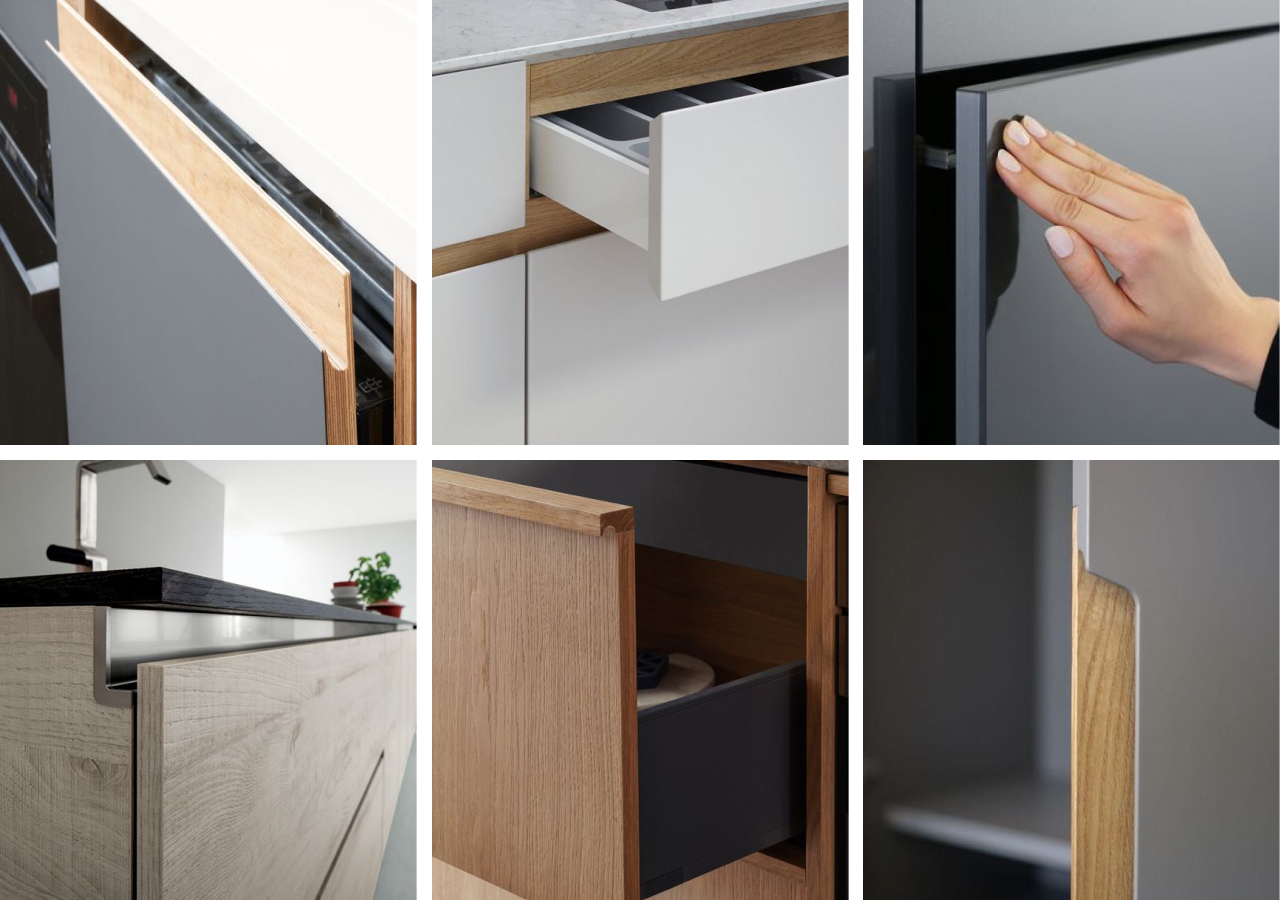
Decorative hardware can pull a kitchen toward a more traditional style, especially when every door and drawer has a large or highly detailed handle.
Slim pulls, small knobs, edge pulls, or handleless opening systems usually support a cleaner Scandinavian direction. Hardware can still provide contrast, but it should not become the busiest feature in the room.
There is no need to choose the smallest possible handle. It still needs to be comfortable for everyday use. The best option feels visually simple while working well with the size and weight of the door or drawer.
What You Usually Do Not Need to Change
.webp)
In many American kitchens, the basic structure is not the problem. The room may already have a functional layout, sufficient storage, and full-size appliances in sensible positions. What makes it feel less Scandinavian is often the combination of cabinet detail, strong contrasts, harsh lighting, and too much left visible.
That means you may not need to relocate the sink, move the range, or redesign the entire footprint. Surface-level updates can have a meaningful effect when they are coordinated rather than chosen separately.
This is what makes the approach realistic. You are not trying to recreate a compact Nordic kitchen. You are adapting an American kitchen so it feels lighter, quieter, and easier on the eye.
Making Scandinavian Style Work in an American Home
.webp)
A Scandinavian-inspired kitchen should still support the way an American household cooks, stores food, entertains, and uses appliances. It does not need to sacrifice a large refrigerator, generous island, pantry storage, or comfortable seating.
The most successful rooms balance the scale of an American kitchen with the restraint of Scandinavian design. Large elements remain functional, but the cabinetry becomes quieter, the palette becomes more controlled, and the surfaces feel less crowded.
The result should not look like a style was placed on top of the room. It should feel like the kitchen has been edited until the useful parts are easier to see.
Conclusion
Making an American kitchen feel Scandinavian usually does not require a full rebuild. The layout, plumbing, and appliance positions can often stay exactly where they are.
The strongest changes come from simpler cabinet fronts, a calmer color palette, layered lighting, clearer countertops, and a small number of natural materials. Together, these updates can make a large American kitchen feel lighter and more relaxed without making it less practical.
Explore Corner Renovation’s Scandinavian kitchen collections and completed projects for examples of light wood cabinetry, quieter materials, integrated appliances, and simple storage solutions.


