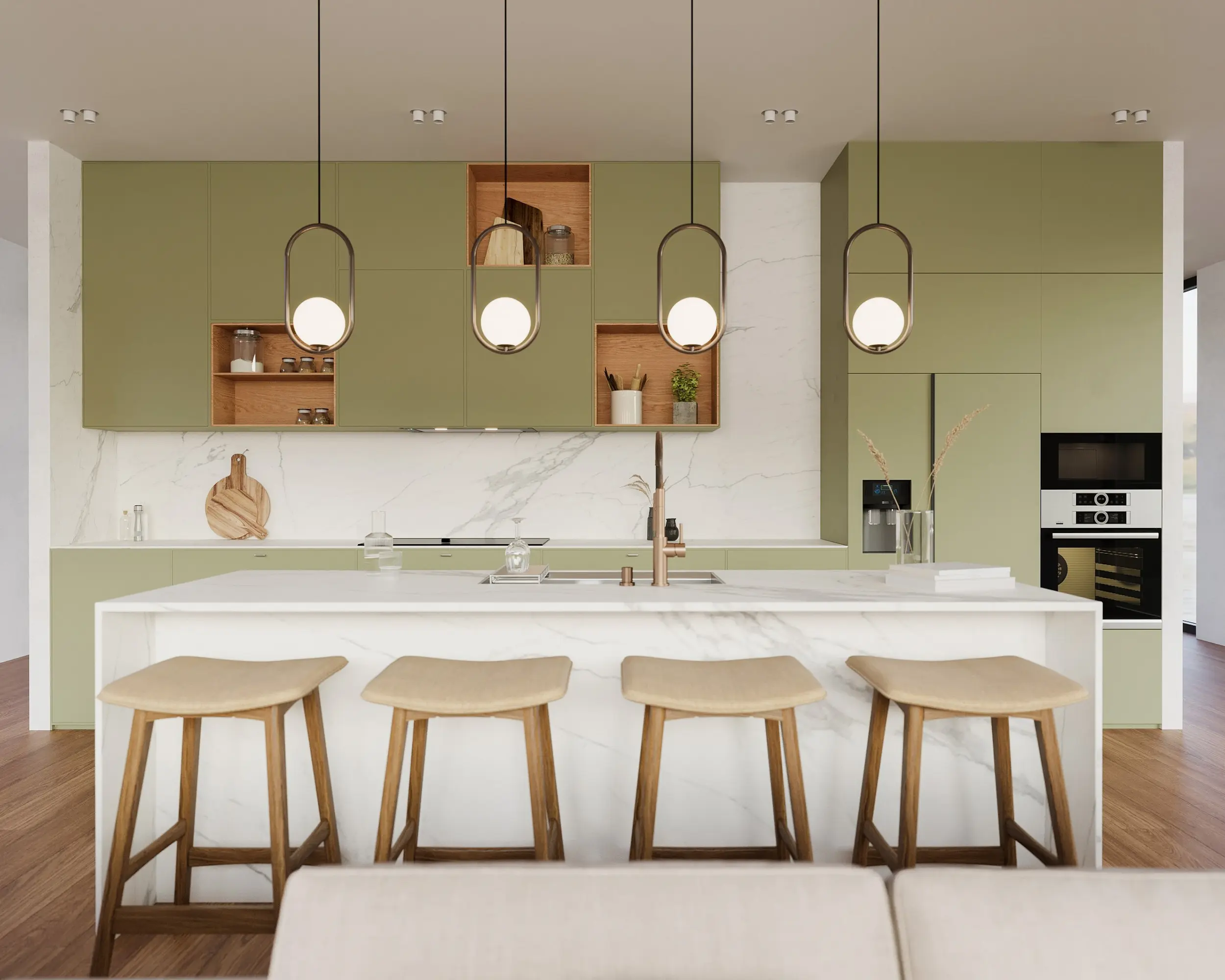
Fisher & Paykel appliances are often chosen for modern kitchens because they have a clean, built-in look. Many models work well with custom cabinetry, especially in kitchens where the goal is a calm, seamless cabinet wall.
But the final result depends on planning. A refrigerator may need custom panels. A dishwasher may need a matching front and handle detail. A cooktop with integrated ventilation may affect the cabinet below, the countertop cutout, and the ducting route.
That is why appliances should be selected before the cabinet drawings are finalized.
Built-In, Integrated, and Panel-Ready Appliances

Built-in appliances are installed into cabinetry, a wall unit, an island, or a counter opening. Integrated appliances go a step further. They are planned to feel visually connected to the cabinet layout.
Panel-ready appliances accept custom cabinet fronts, allowing refrigerators and dishwashers to blend into the kitchen instead of standing out as separate appliances.
For modern European-style kitchens, panel-ready appliances are often the strongest choice because they help the kitchen feel more architectural and less visually busy.
What to Plan Before Cabinet Drawings
Appliance planning should happen early. Even small details can affect cabinet sizes, panels, fillers, utilities, clearances, and installation.
This is where custom cabinetry makes a big difference. The appliances are not added at the end. They shape the layout from the beginning.
Fisher & Paykel Refrigerator

A Fisher & Paykel refrigerator can be used as a visible stainless steel appliance or as a panel-ready refrigerator built into a tall cabinet wall.
The panel-ready option is often better for a minimalist kitchen because it allows the refrigerator to sit quietly within the cabinetry. Instead of becoming a large metal object in the room, it becomes part of the cabinet composition.
Before designing around the refrigerator, confirm the exact model, width, height, depth, door swing, ventilation requirements, and panel specifications. If the model has an ice maker or water dispenser, the water line also needs to be planned early.
Fisher & Paykel Microwave Oven
.webp)
A built-in microwave or compact oven helps keep the countertop clear. It can be placed in a tall cabinet, appliance wall, island, or pantry area.
The best location depends on how often it is used. A daily-use microwave should be easy to reach and close to the prep area. A less frequently used microwave can sit more discreetly in a pantry wall or secondary appliance zone.
The main things to check are the cabinet opening, trim condition, ventilation, electrical location, and comfortable height. A built-in microwave should feel intentional, not squeezed into the nearest available cabinet.
Fisher & Paykel Steam Oven
.webp)
A steam oven works well for homeowners who want more cooking flexibility than a standard oven setup. Depending on the model, it can support steam cooking, reheating, baking, or combination cooking.
In a custom kitchen, a steam oven usually works best in a tall appliance wall. It can be stacked with a conventional oven, microwave, warming drawer, vacuum seal drawer, or storage drawer.
The appliance stack should be planned as one composition. Each appliance needs the right opening, clearance, ventilation, electrical planning, and height for daily use.
Fisher & Paykel Cooktop With Integrated Ventilation

A cooktop with integrated ventilation can be a good choice when you want to avoid a large overhead hood. This is especially useful on an island or in a clean, minimalist wall layout.
The benefit is visual lightness. Without a visible hood, the kitchen can feel more open and less interrupted.
But this type of cooktop affects more than the countertop. It may change the cabinet below, the ducting or recirculation route, drawer space, electrical planning, and service access.
Before choosing it, confirm:
- countertop cutout
- cabinet depth below the cooktop
- ducting or recirculation route
- clearance from drawers or storage
- access for cleaning and service
- electrical requirements
- compatibility with the countertop material
This appliance should be selected before cabinet production, not after.
Fisher & Paykel Dishwasher
.webp)
A panel-ready Fisher & Paykel dishwasher can blend into the base cabinet run with a matching cabinet front.
This is useful near the sink, where the kitchen usually needs several functions close together: sink, dishwasher, trash pull-out, cleaning supplies, and dish storage.
The front panel, handle, toe kick, and reveal lines need to be coordinated with the rest of the cabinetry. If the kitchen uses recessed pulls or handleless fronts, the dishwasher should follow the same logic.
Dishwasher placement should also be planned with daily movement in mind. The door or drawer should open without blocking the sink, trash pull-out, or main walkway too much.
How Appliances Shape the Cabinet Layout
.webp)
In a custom kitchen, appliances do not simply fill empty spaces. They shape the cabinet plan.
A refrigerator can define the tall cabinet wall. An oven stack can set the vertical proportions. A dishwasher affects the sink zone. A cooktop with integrated ventilation changes the cabinet and ventilation planning below.
When the appliances are chosen early, the kitchen can be designed around real dimensions and real installation needs. The result looks cleaner, works better, and is easier to install.
Are Fisher & Paykel Appliances Right for Every Kitchen?

Fisher & Paykel appliances make the most sense when the kitchen benefits from built-in, integrated, or panel-ready design.
They are especially useful in modern custom kitchens, European-style kitchens, minimalist kitchens, and cabinet walls where a seamless look matters.
They may be less necessary for a very budget-driven kitchen, a layout with standard freestanding appliances, or a design where visible stainless steel appliances are part of the look.
The best choice depends on both appearance and planning. A good appliance still needs the right cabinet opening, utility locations, ventilation, panels, and installation conditions.
Conclusion
Fisher & Paykel appliances can support a clean, modern kitchen, but the best results come from planning them as part of the cabinetry from the start.
For a custom kitchen, the goal is not just to choose attractive appliances. It is to make sure the refrigerator, dishwasher, ovens, cooktop, panels, handles, clearances, utilities, and cabinet layout all work together.
That is what creates the seamless look people often want from a modern European-style kitchen: not just hidden appliances, but a kitchen where every detail feels properly integrated.