
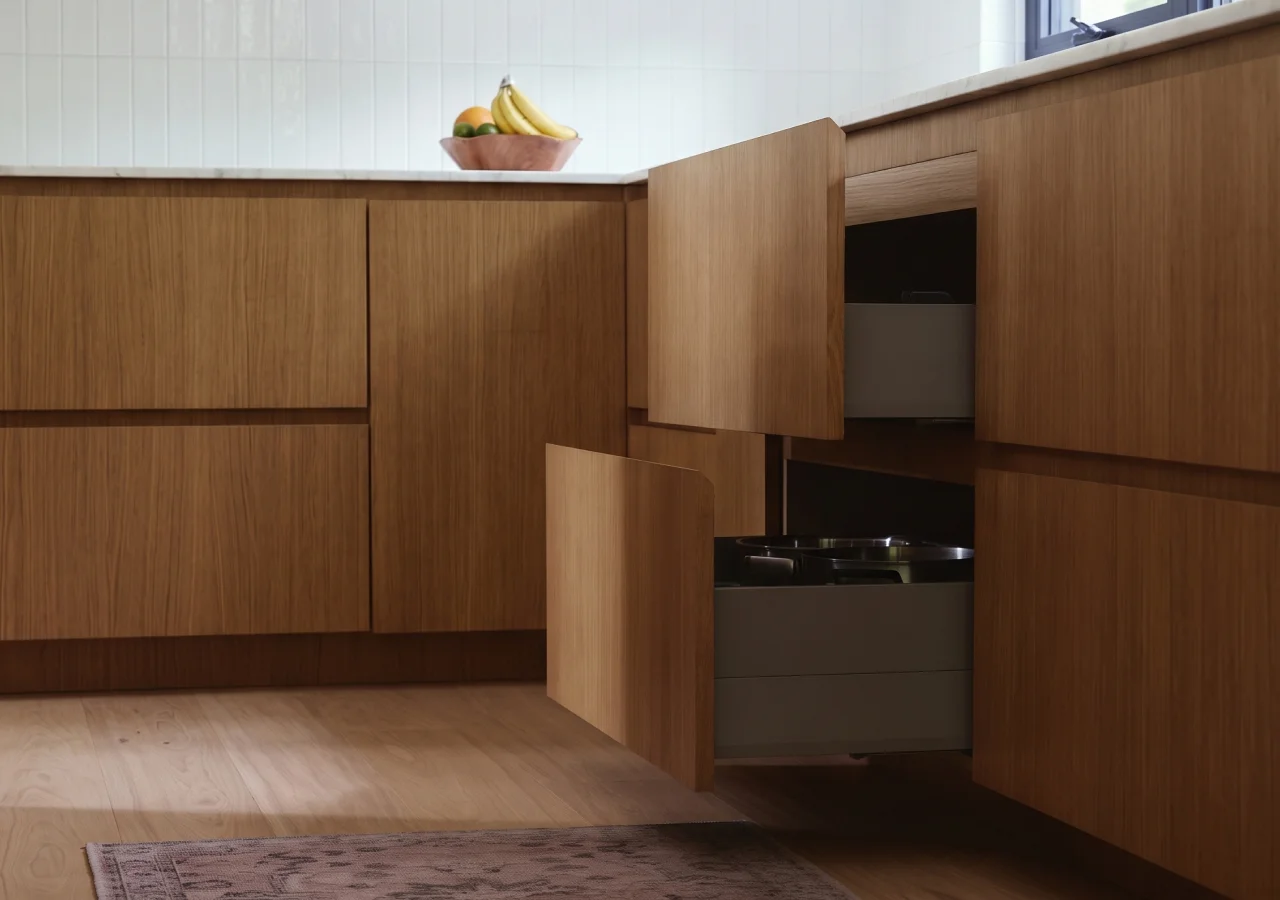
A storage mechanism can look convenient in a kitchen rendering but feel different once the cabinet is installed and filled. An inner drawer may require an extra movement, a pull-out shelf may not stay in place when extended, and a pull-down unit may be difficult to operate at its intended height.
Before ordering, check the complete opening sequence, usable space, expected load, and maintenance requirements. These tests help reveal problems that are easy to overlook when reviewing cabinet drawings.
1. Test the Complete Opening Sequence
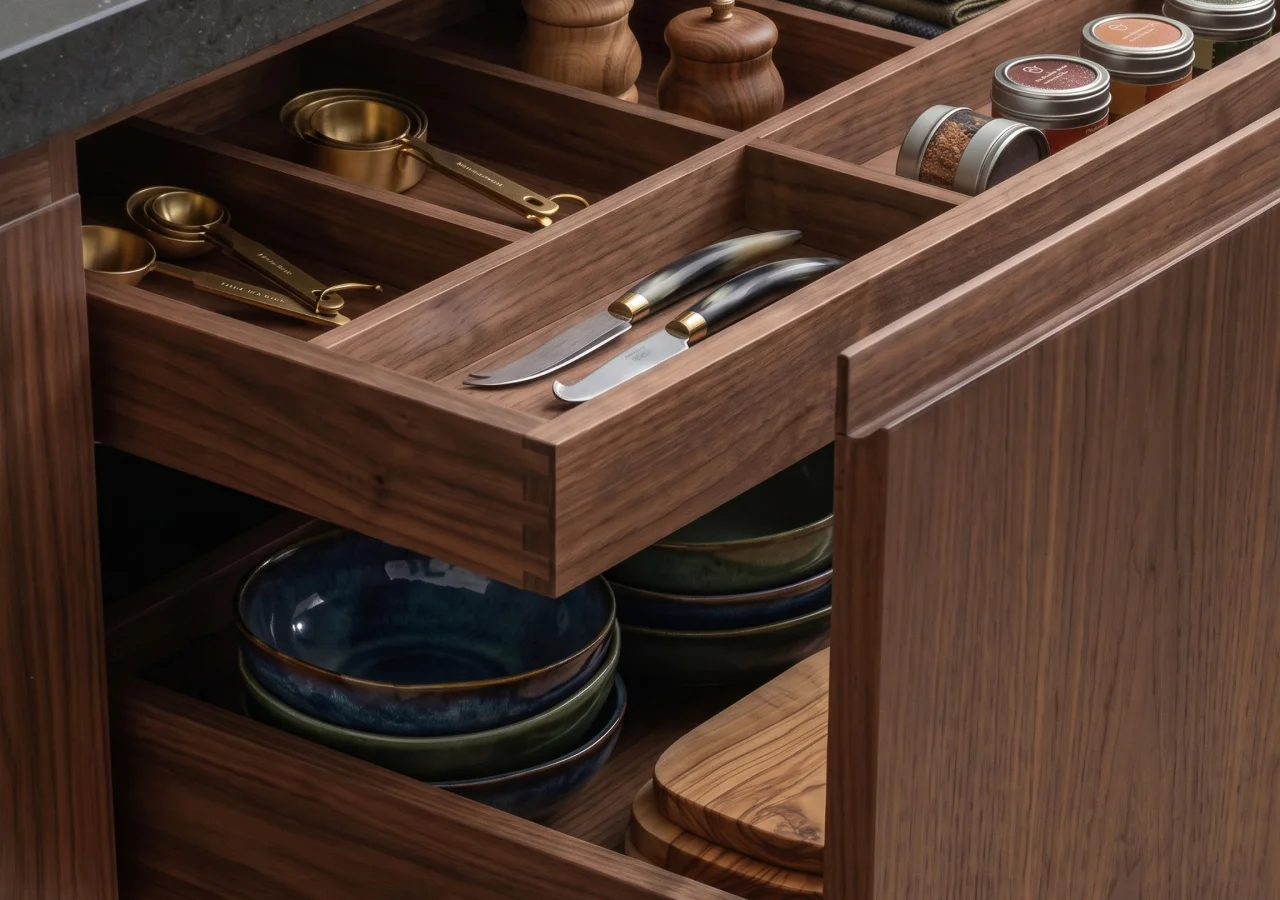
A working display can show you more than a cabinet rendering. Open the cabinet, pull out the mechanism, remove an item, put it back, and close everything. Repeat the sequence as you would during a normal cooking routine, rather than testing only whether the hardware moves smoothly.
Inner drawers are a useful example. Depending on the cabinet design, you may need to open an exterior door or front before reaching the internal drawer. That additional step may be acceptable for occasional storage but inconvenient for something accessed repeatedly while preparing meals. Compare this with a standard exterior drawer, where the contents are available in one movement.
In one Corner design consultation, a homeowner preferred large drawers over cabinets with doors because of easier access. The internal organization was still being planned. This illustrates why the access method should be considered before choosing dividers and accessories.
Compare the Opening Sequence
Pay attention to the final part of each movement. A drawer that opens easily may still be awkward to close when your hands are occupied. A pull-down unit may be comfortable to lower but harder to return to its upper position.
2. Compare Usable Space, Not Cabinet Size
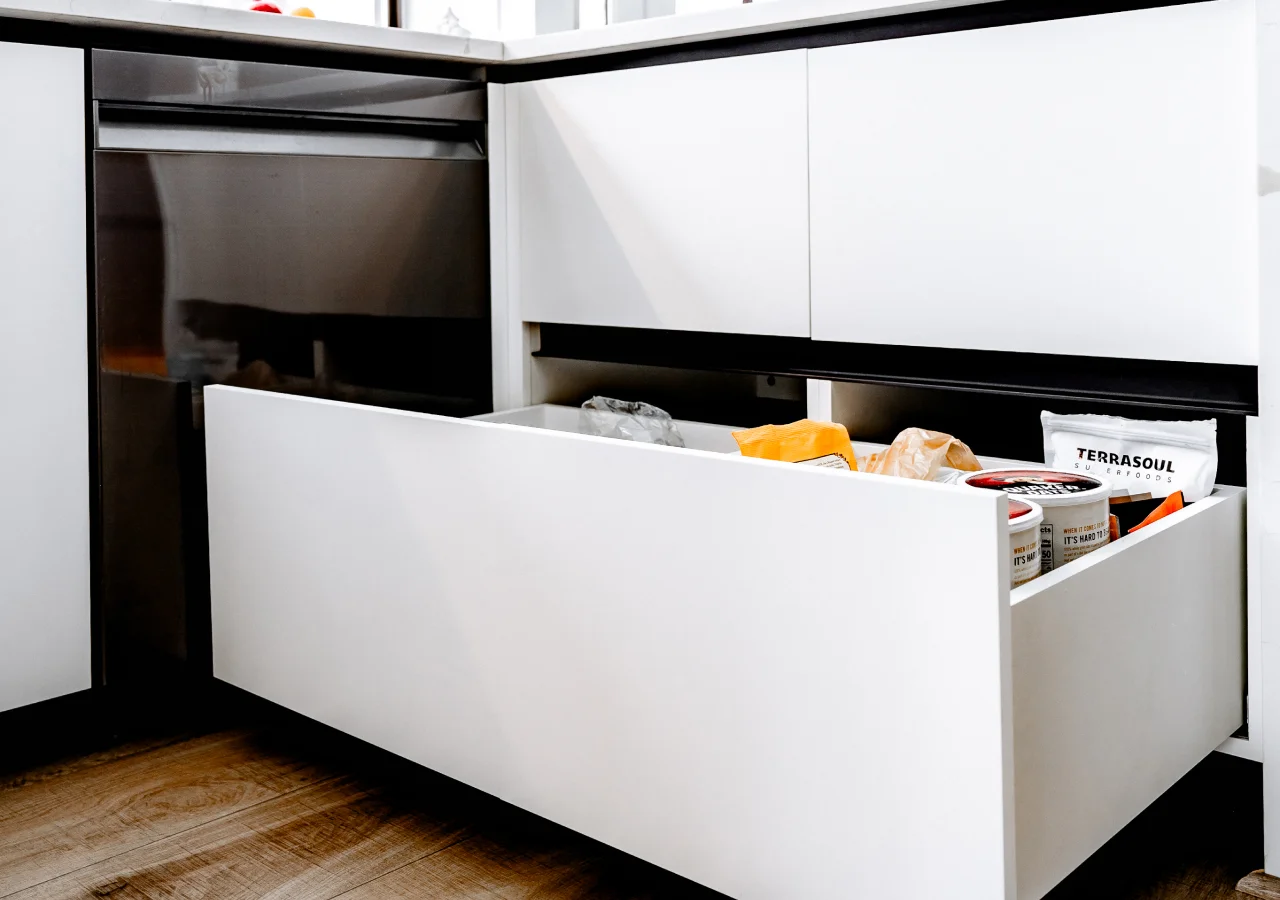
Two cabinets with identical exterior dimensions can provide different usable storage once their mechanisms are installed. Drawer sides, runners, mounting brackets, and moving components all occupy space. Instead of comparing cabinet sizes alone, check whether the intended items fit and can be removed without difficulty.
For an inner drawer, confirm the clear height above the contents and whether the drawer extends far enough to reach items at the back. For a pull-out shelf, check whether a stored appliance can be lifted off without hitting the shelf above or the surrounding cabinet.
A pull-out shelf brings its contents forward and may have open sides or low retaining edges, depending on the design. In one Corner design discussion, replacing an internal drawer with a pull-out shelf was proposed for appliance storage. The distinction matters because an appliance may be easier to lift from a relatively open platform than from a drawer with taller sides. The appropriate choice depends on the appliance dimensions and the available clearance.
Check whether the shelf should stay open while being loaded. Some systems offer a lock-open feature to hold the shelf in its extended position. For example, Blum's pull-out shelf lock is designed for compatible runner systems. Ask whether the selected shelf needs this feature, whether it is included, and how the lock is released.
Storing an appliance on a pull-out shelf does not automatically mean it can be operated there. The appliance manufacturer's requirements for ventilation, stability, electrical connections, and surrounding clearances still apply. Storage and operation should be approved separately.
For more on cabinet interiors and pantry organization, see Scandinavian Kitchen Pantry Design.
3. Check Reach and Effort With the Intended Load
An empty mechanism may feel smooth on a showroom display, but the experience can change when it carries everyday contents. If the showroom permits a loaded demonstration, test representative contents within the manufacturer's stated limits. If that is not possible, request the selected manufacturer's operating and capacity specifications.
Start with the expected weight. A drawer used for lightweight utensils has different requirements from a shelf holding a heavy kitchen appliance. Check that the complete system, including its runners, fixings, and cabinet construction, is suitable for the planned load.
Ask whether the stated capacity refers to stored contents alone or includes the drawer or shelf itself. Do not assume a weight rating applies to every product in the same category.
Pay Particular Attention to Pull-Down Storage
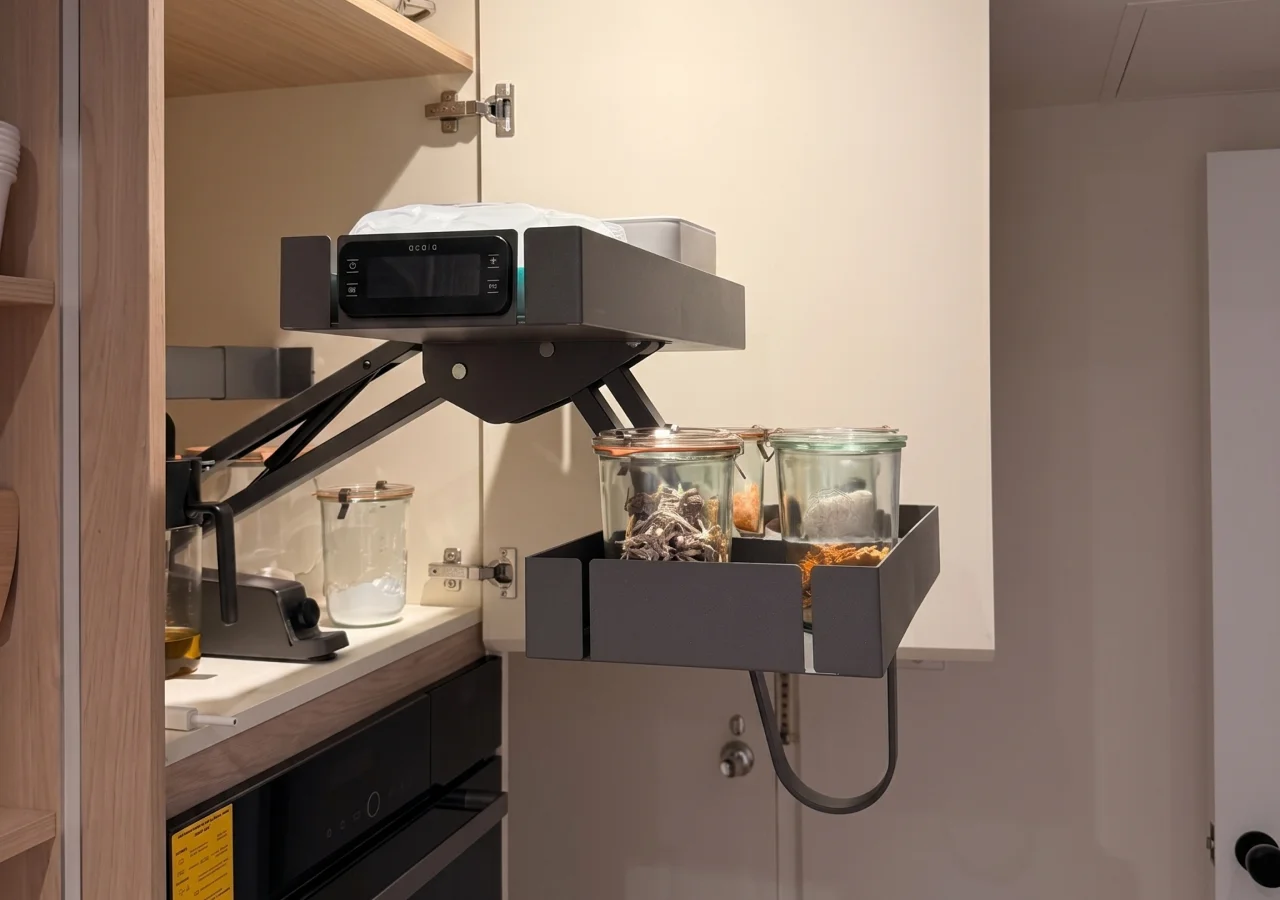
Pull-down systems introduce an additional movement: the contents travel forward and downward from an upper cabinet. This can improve access in certain layouts, but comfort depends on the particular mechanism, installation height, and person using it.
When evaluating a pull-down unit, check three parts of the movement:
- Reaching the handle: Can the intended user reach and grip it comfortably from the floor?
- Lowering the contents: Does the unit move through a clear path without interfering with the countertop, backsplash, faucet, or other features?
- Returning the unit: Can the user raise the loaded mechanism without uncomfortable stretching or excessive force?
Check the Specific Product Documentation
Request the exact manufacturer and model, then check its cabinet dimensions, mounting requirements, movement clearances, operating instructions, and load limits. Products such as Kesseböhmer's iMove have model-specific specifications; these should not be applied to every pull-down system.
A pull-down mechanism should not be assumed to eliminate the need for a step stool or accommodate every user's reach. If accessibility is a priority, the intended user should test the selected system wherever practical.
4. Ask What Happens After Installation
A storage mechanism will be used repeatedly over the life of the kitchen. Before approving it, find out what adjustments and maintenance it may require and who can provide support if the mechanism stops working correctly.
Some systems allow adjustments to alignment or movement. Others have more specialized components that may require manufacturer-specific replacement parts. Ask what can be adjusted after installation, whether the hardware is accessible for service, and how replacement components can be obtained.
Cleaning matters as well. Crumbs, dust, and spills can collect around moving storage fittings. Check the manufacturer's cleaning instructions, including whether trays or shelves can be removed safely and whether runners require particular maintenance. Avoid assuming that all mechanisms can be cleaned or lubricated in the same way.
These are questions to confirm with the hardware supplier or installer, rather than assumptions about what is included in a kitchen renovation warranty.
Conclusion
Before ordering inner drawers, pull-out shelves, or pull-down storage, test how each system opens, carries its intended contents, and returns to its closed position. Check the installation clearances and maintenance requirements as carefully as the visible cabinet design. A mechanism that works well on a display still needs to fit your kitchen layout and daily routine.
Planning new kitchen cabinetry? Get your kitchen estimate with Corner Renovation and discuss which storage mechanisms make sense for your space.


