
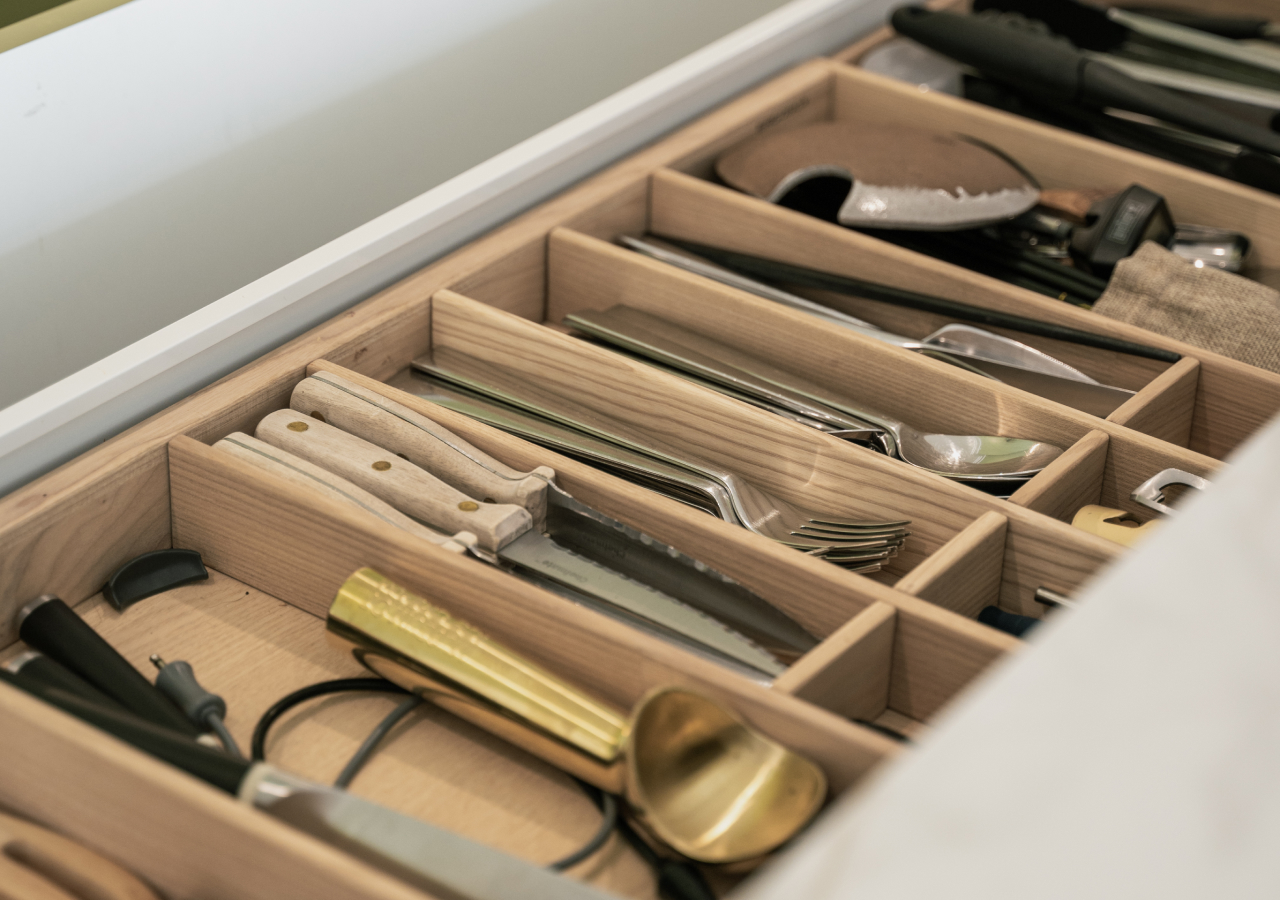
The smallest drawers often decide how a kitchen feels day to day. When cutlery and utensils live in one messy catch-all, even a beautiful minimalist kitchen can feel chaotic. When they’re sorted into clear zones with trays, inner drawers, and simple dividers, setting the table, cookin,g and unloading the dishwasher suddenly take less effort.
This guide focuses on cutlery organizers and inner drawers: the low-profile details that quietly transform kitchen storage. We’ll look at how they work together, a few layout examples you can copy straight into your plan, and what to prioritize if you’re planning a new kitchen or updating existing drawers.
Why Cutlery Organizers Matter in Kitchen Storage
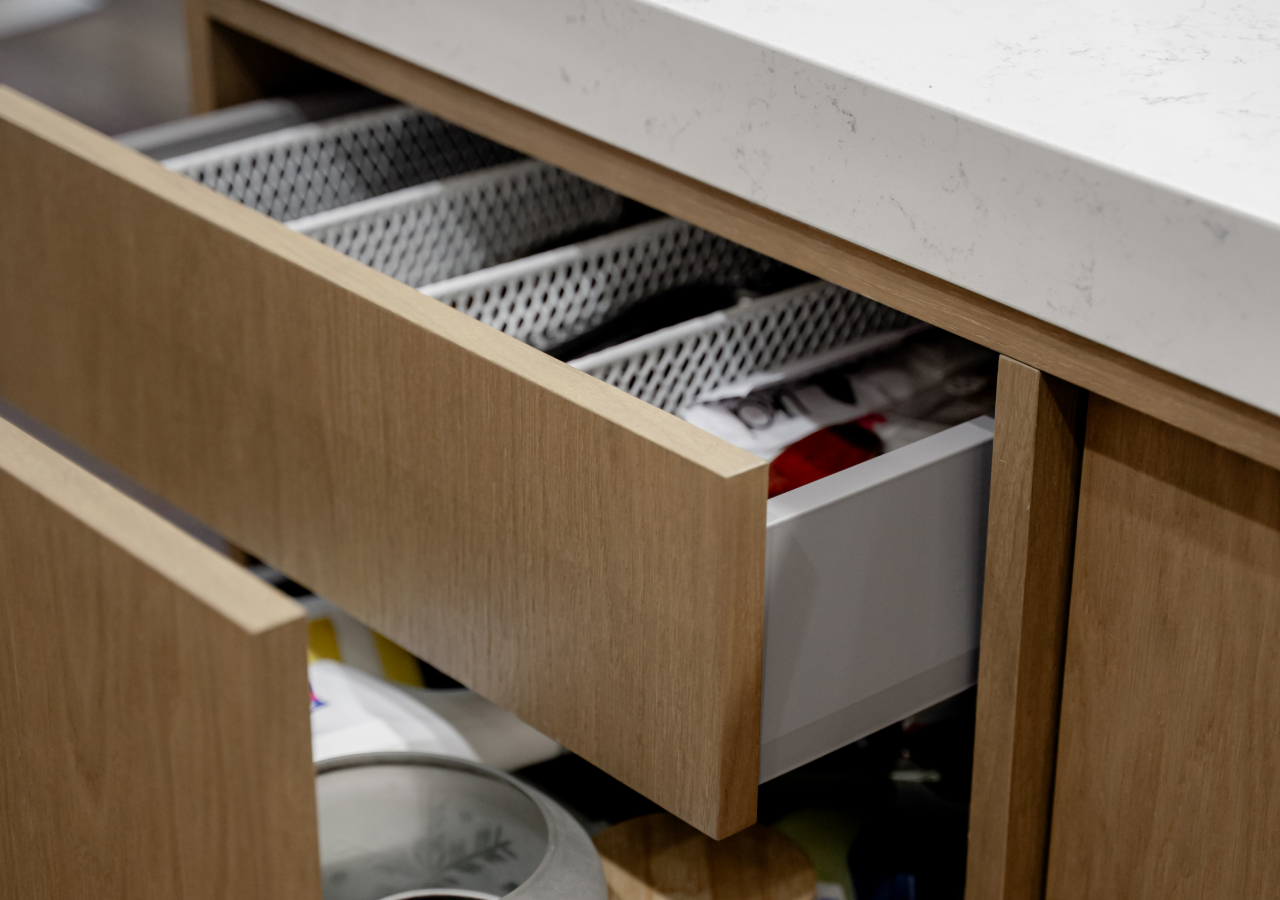
Minimalist kitchens are designed to look calm on the outside. Flat fronts, continuous lines, reduced visual noise. But that calm only holds up if the inside works. When you open a drawer and it’s chaotic, the contrast is immediate: the kitchen looks composed, but it doesn’t feel composed.
Cutlery is one of the most-used categories in any home, which is why small friction adds up fast. If forks and spoons migrate, if knives get buried, if serving tools tangle with everyday utensils, you end up spending time (and mental energy) solving the same problem over and over. A dedicated cutlery layout removes that daily friction. You open one drawer, grab what you need, and close it without “fixing” anything.
That’s also why cutlery trays and cutlery organizers matter more in minimalist kitchens than in traditional ones. In a classic kitchen, countertop canisters and visible utensil crocks are common. In a handleless or Japandi kitchen, those extras quickly turn into clutter. A strong cutlery drawer layout supports cleaner counters, faster table setting, and easier unloading from the dishwasher, because everything already has a stable home inside the drawer.
How Inner Drawers Work with Cutlery Trays
.webp)
An inner drawer is a shallow drawer that sits inside (or just beneath) a deeper drawer space, creating a second level within the same cabinet zone. Instead of one deep drawer that becomes a mixed pile, you get a top layer that stays tidy and a lower layer for the bulkier or less-used items.
This is why inner drawers pair so well with cutlery trays. The top visible layer becomes your everyday “grab and go” zone: forks, knives, spoons, teaspoons—organized and easy to reset. The inner drawer (or the secondary layer) becomes the overflow that usually breaks a cutlery tray over time: peelers, thermometers, kitchen scissors, measuring spoons, bottle openers, small whisks, and odd tools that don’t fit cleanly in standard compartments.
In many of our projects, a cutlery tray sits in the top drawer and an inner drawer is hidden just below it. The top level holds forks, knives and spoons in simple organizers. The inner drawer keeps peelers, bottle openers and kitchen scissors flat and visible, so they’re easy to grab but never tangle with cutlery. You open one clean-lined front and see a composed, layered system instead of a deep, overfilled drawer.
3 Drawer Layouts You Can Copy
Below are three copy-ready layouts you can map onto real drawers. Think of them as templates: the goal isn’t perfection on paper, it’s a drawer that stays organized after a normal week of cooking and unloading.
Layout 1: Everyday Cutlery Drawer Near the Dishwasher
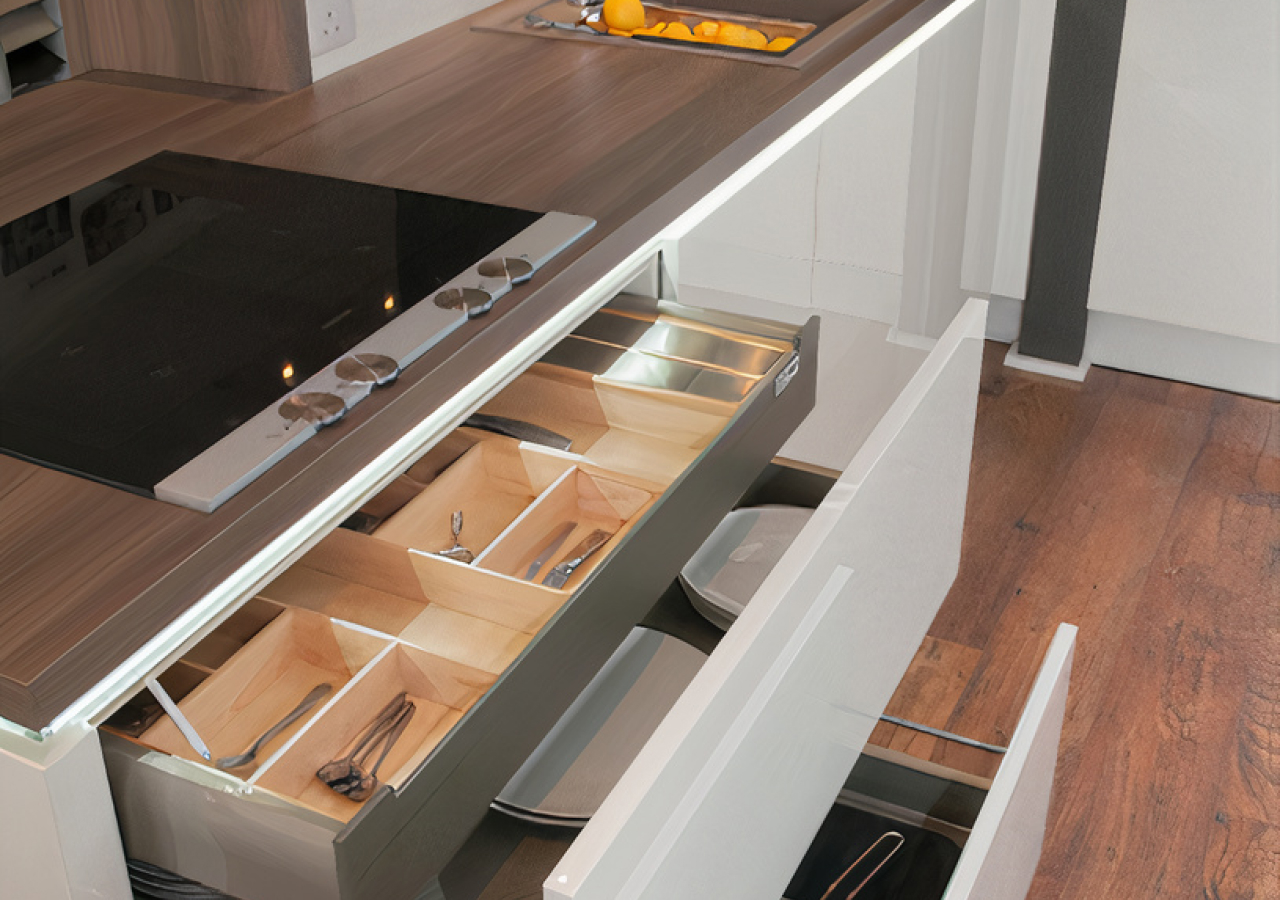
This is the most important drawer in most kitchens because it supports the fastest repeating routine: unloading the dishwasher and setting the table. Place it where it reduces steps, typically between the sink area and wherever you serve meals. When this drawer is in the right place and logically organized, your kitchen instantly feels easier.
Top tray
- Left: everyday forks
- Middle: spoons + teaspoons
- Right: table knives
Inner drawer underneath
- Serving spoons
- Salad servers
- Kids’ cutlery / reusable straws
- Bottle opener, corkscrew
This layout keeps the daily set extremely stable while giving “frequently used but not daily” items a home that doesn’t disturb the cutlery tray.
Layout 2: Cooking Tools Drawer Beside the Cooktop
.webp)
If you cook often, the most annoying thing is stopping mid-flow to hunt for tools. This drawer fixes that by creating a “cooking command” zone right next to the cooktop (or the main prep run), so tasting, flipping, stirring and plating feels seamless.
Top tray (shallow)
- Tasting spoons
- Small offset spatula
- Thermometer
- Small tongs
Inner drawer (deeper)
- Left: spatulas
- Middle: tongs & ladles
- Right: whisks & mashers, separated by a simple divider
The key idea here is separation by function. The top tray holds the small, precise tools you grab constantly; the deeper layer holds the larger tools that otherwise create clutter and noise.
Layout 3: Multi-Use Island Drawer for Open-Plan Kitchens
.webp)
In open-plan homes, the island often becomes the center of daily life: prep, snacks, casual meals, homework, entertaining. A multi-use island drawer reduces clutter on the seating side because it stores the essentials exactly where people use them—without adding countertop containers.
Top tray
- Everyday forks, knives, spoons (for island seating)
Inner drawer
- Stack of napkins
- Placemats
- Coasters
- Small box for candles, lighter, bottle stoppers
This layout is a lifestyle support. It makes the island feel like a calm, functional zone even when the kitchen is busy.
Small Upgrades That Make These Layouts Work
.webp)
These layouts only feel effortless if the system stays stable after real use. A few simple upgrades prevent trays from drifting, stop categories from blending together, and make the drawer easy to reset without thinking.
A non-slip mat under the tray keeps the insert from shifting as the drawer opens and closes, which is often the difference between a drawer that stays organized and one that slowly falls apart. Adjustable dividers help when your utensil mix changes over time, so you can adapt the layout without turning the whole drawer into a catch-all.
Keeping tray materials consistent (wood or a neutral plastic) also matters more than people expect: when the interior looks uniform, the drawer reads calmer and more intentional instead of piecemeal. And for households with kids or frequent guests, subtle labeling on the inner drawer edge can remove hesitation—people put things back in the right place without needing instructions, and the system holds up longer.
How to Choose the Right Organizer
.webp)
Choose an organizer based on three things: the drawer size, your utensil mix, and how you cook. Once you’re clear on those, it becomes obvious whether you need a tray only, or a tray plus dividers and an inner drawer.
Start with what you use most. If the drawer needs to support daily forks, knives, and spoons with zero friction, prioritize a tray layout that gives those items the clearest, easiest access. Then account for the extras that are specific to your household—chopsticks, cheese knives, baking tools, serving utensils—so they don’t end up invading the cutlery compartments over time.
Next, match the organizer to the drawer itself. Deep drawers are perfect candidates for a two-level system: a cutlery tray on the top level, and a secondary zone underneath for larger items or less-used tools. Narrow drawers usually work better with clean compartments and a dedicated long-utensil lane so serving tools don’t disrupt the main tray.
Material choice should support the kitchen’s overall feel and how hard the drawer works. Wood inserts add warmth and a premium, cohesive look, especially in natural finishes like walnut or oak. Metal or modular inserts can be more practical for heavy daily use and easier to adapt as your tools change.
Finally, prioritize function over everything. If the organizer slides, doesn’t fit well, or creates awkward dead space, it won’t stay organized for long. The best system is the one that feels stable, easy to reset, and effortless to use in the middle of a busy day.
Planning Cutlery Storage in a New Kitchen vs Existing One
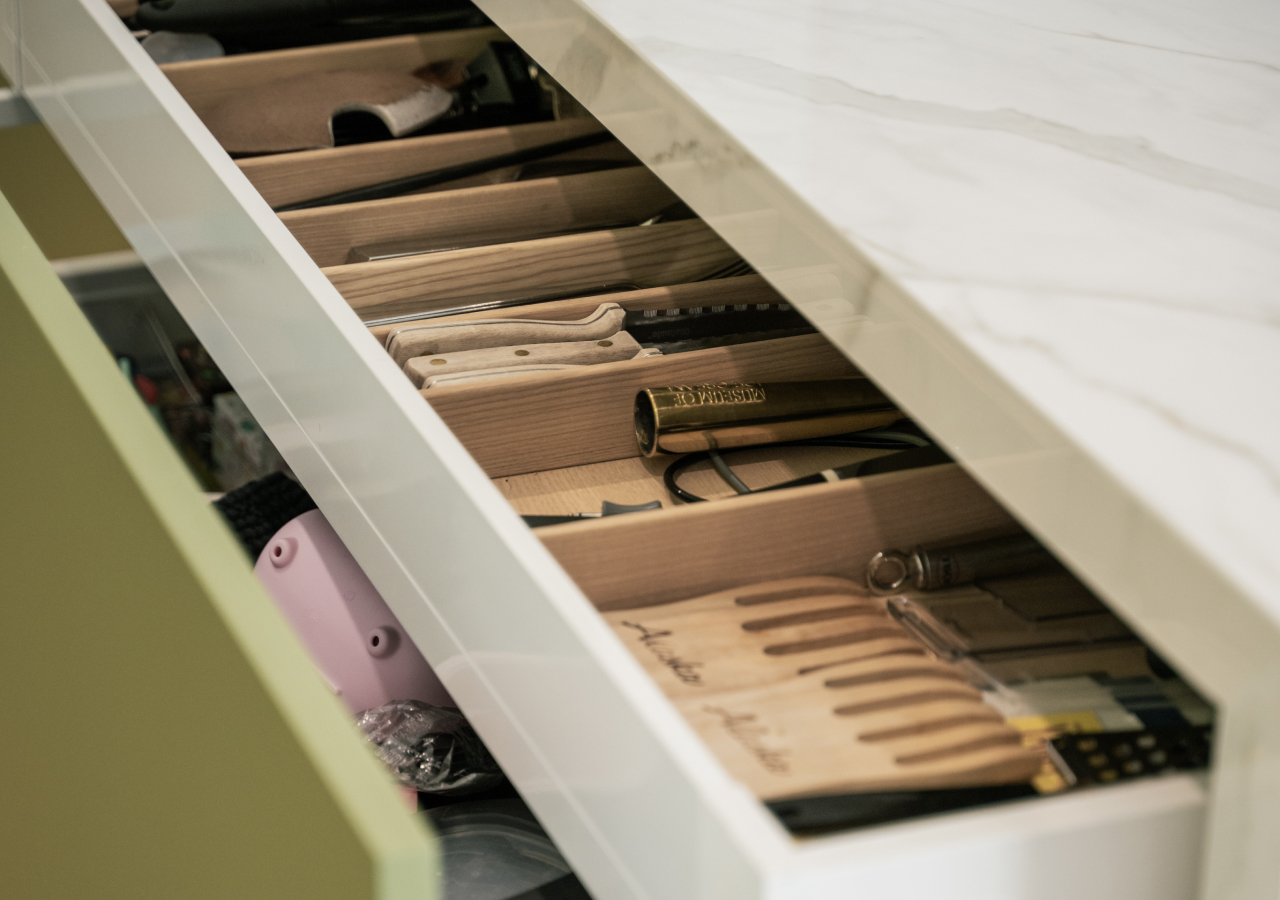
If you’re planning a new kitchen, cutlery storage is easiest to get right when you start with workflow. Identify where you’ll unload the dishwasher most often and where table setting naturally happens. Then reserve a dedicated drawer stack for cutlery trays and a secondary layer (inner drawer) close by. The biggest upgrade is a placement that reduces steps. If you coordinate tray sizing early, the insert fits correctly from day one and the system feels built-in rather than improvised.
If you’re updating existing drawers, start with internal measurements (width and depth inside the drawer box) and choose a tray system that fits snugly. If you can’t add an inner drawer, the next best solution is creating a second zone using dividers or a dedicated long-tool lane so cutlery doesn’t get mixed with awkward utensils. The main goal is to reduce countertop clutter by moving everyday tools into stable drawer categories, rather than adding more countertop containers to compensate for drawer chaos.
Conclusion
Cutlery organizers and inner drawers can look like small details, but they shape how a kitchen feels every single day. They reduce clutter, protect tools, and make routines like cooking, unloading, and resetting more intuitive. When the inside of the drawers is planned with the same care as the outside of the cabinetry, the kitchen becomes calmer, more livable, and easier to keep looking good.


