
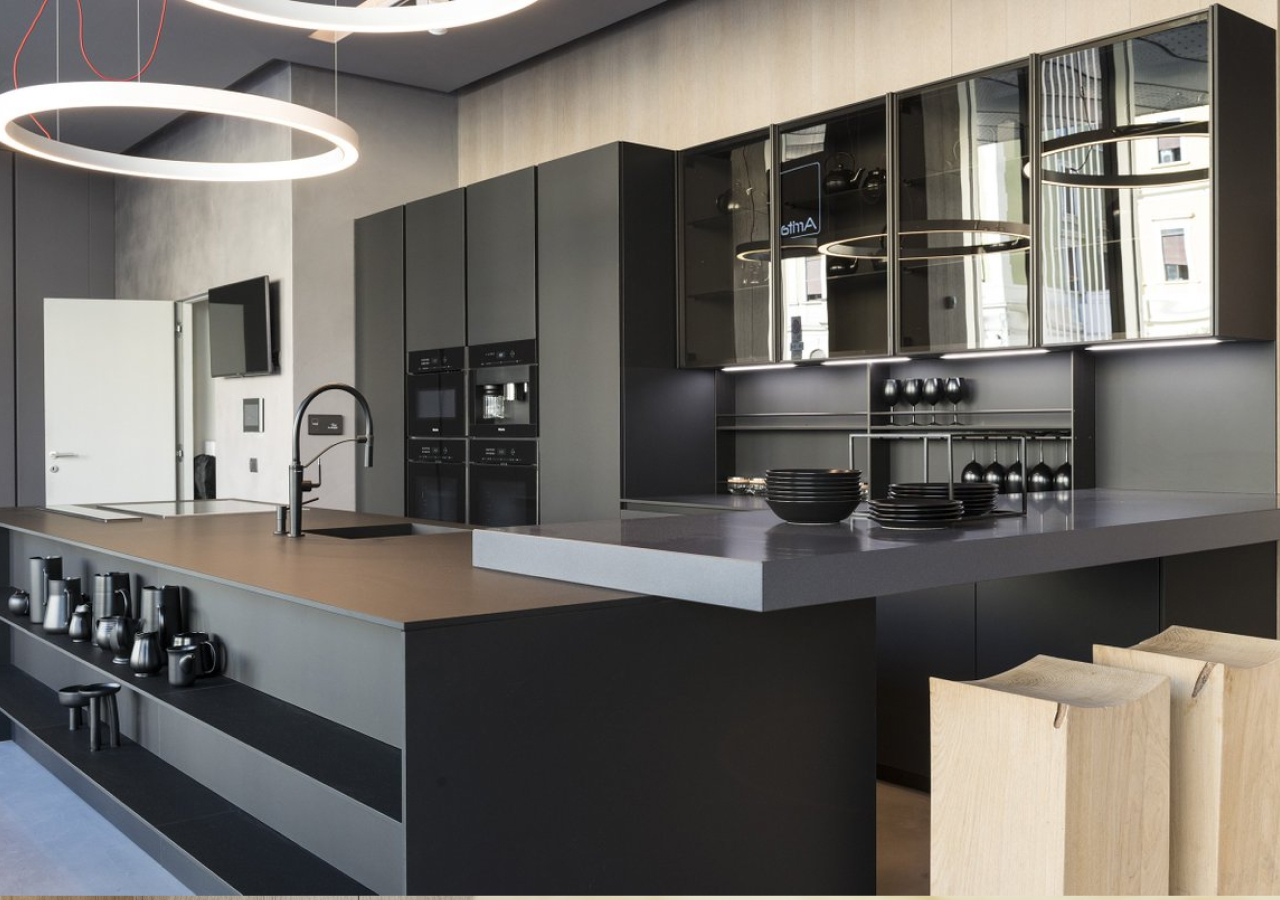
FENIX HPL board is a decorative panel made by applying a FENIX surface to a rigid core such as MDF or particleboard. In kitchens, it is commonly used for cabinet fronts, side panels, tall storage walls, appliance garage doors, island panels, and selected work surfaces.
The main appeal is its extremely matte appearance. FENIX reflects very little light, feels soft to the touch, and is designed to reduce visible fingerprints. However, the finished board is not one single material. Its performance also depends on the core, edge construction, fabrication, and intended application.
What Does FENIX HPL Board Mean?

The term “FENIX HPL board” is commonly used for a fabricated panel with FENIX applied to its visible face. It is important to separate the decorative surface from the panel beneath it.
FENIX is a family of interior materials developed by Arpa Industriale. Its low-reflective surface is created through a manufacturing process that produces the material’s characteristic matte appearance and soft feel.
The core of a finished kitchen panel may be MDF, particleboard, or another engineered board. A reverse or balancing layer may also be added to help keep the panel stable. The exact construction should be listed in the cabinet or material specification rather than assumed from the word “FENIX.”
How Is FENIX HPL Board Made?
.webp)
A finished FENIX panel usually includes the decorative FENIX surface, an engineered core, a reverse layer, and finished edges. The visible surface provides the color, matte appearance, and tactile quality. The core gives the panel its structure and affects its weight, machining, and moisture performance.
The back may use a matching surface, a coordinated laminate, or another balancing material. The perimeter is then completed with edge banding or another approved finishing method. Edge quality is especially important because it protects the core and affects how seamless the finished door or panel looks.
Two products can both be described as FENIX boards while using different cores, edges, and reverse materials. For that reason, homeowners should compare the full panel specification rather than choosing by surface color alone.
Why Does FENIX Look and Feel Different?

FENIX is known for its low light reflectivity, soft-touch finish, and reduced fingerprint visibility. These characteristics make it especially suitable for large cabinet walls, handleless kitchens, and darker matte finishes that might otherwise show every touch.
The matte effect comes from the microscopic structure of the surface. Light is diffused rather than reflected as a strong glare, which gives the material a softer and quieter appearance.
Anti-fingerprint does not mean fingerprint-proof. Oils, dust, food residue, and cleaning-product film can still appear, particularly on darker colors. The finish is designed to make these marks less noticeable than they may be on glossy or conventional matte surfaces.
Where Does FENIX HPL Board Work in a Kitchen?
.webp)
FENIX is commonly used for flat cabinet fronts, handleless doors, pantry walls, panel-ready appliances, appliance garage doors, island panels, and finished cabinet sides. It can also continue into bathroom vanities, laundry cabinetry, shelving, and other built-in storage.
The material works especially well when the design calls for one consistent matte finish across several elements. For example, the same color can continue across lower cabinets, tall storage, appliance panels, and the sides of an island.
Some FENIX products can also be used for horizontal work surfaces. However, countertop use requires a suitable product, core, edge construction, support, and installation method. A FENIX cabinet front should not automatically be assumed to have the same specification as a FENIX countertop.
FENIX HPL Board vs Other Cabinet Materials
.webp)
The table below compares common cabinet-front options. Exact performance depends on the manufacturer, core, coating, edge construction, and fabrication quality.
| Material | What It Is | Main Advantages | Main Tradeoffs | Common Kitchen Uses |
|---|---|---|---|---|
| FENIX HPL board | FENIX surface applied to an engineered core | Extremely matte, soft-touch, low glare, and reduced fingerprint visibility | Edges and core must be specified correctly; not resistant to every scratch, impact, or heat source | Slab fronts, handleless kitchens, tall panels, appliance garages, and island panels |
| Painted MDF | MDF finished with paint, lacquer, or another sprayed coating | Broad color choice, smooth finish, and support for routed details | Can chip or show wear at corners; finish quality depends heavily on preparation and coating | Painted fronts, shaker doors, routed fronts, and custom colors |
| Standard laminate | Decorative laminate bonded to a panel core | Practical, consistent, easy to clean, and available in many colors and patterns | May feel less tactile or refined than specialist matte surfaces | Cabinet fronts, interiors, utility areas, and panels |
| Wood veneer | Thin real-wood layer applied over a stable core | Natural grain, warmth, variation, and premium material character | Natural variation must be planned; usually requires careful grain matching and finish approval | Oak or walnut fronts, islands, tall cabinetry, and feature panels |
FENIX is most useful when the design calls for a uniform matte color and a quiet, architectural surface. Wood veneer is stronger when natural grain and variation are important. Painted MDF provides greater freedom for custom colors and routed profiles, while standard laminate can be a practical choice for controlling cost or finishing secondary areas.
Pros and Cons of FENIX HPL Board
Advantages

A calm, low-glare finish
FENIX works well in minimalist, Scandinavian, Japandi, and contemporary kitchens. Its low light reflectivity allows large cabinet walls to feel softer and less visually dominant.
A tactile surface
The soft-touch finish gives cabinet fronts a different feel from standard laminate, glossy acrylic, or painted surfaces.
Reduced fingerprint visibility
Fingerprints are generally less visible than on glossy fronts or many conventional dark matte surfaces. This can be useful on handleless doors and high-touch pantry walls.
Consistent color across multiple elements
The same material direction can continue across doors, drawer fronts, panels, appliance garages, and selected work surfaces.
Treatment of some superficial micro-scratches
Superficial micro-scratches may sometimes be treated using the manufacturer’s approved thermal-healing instructions. This benefit applies to minor surface marks, not every type of damage.
Tradeoffs

It is not damage-proof
Sharp objects, strong impacts, deep cuts, and abrasive cleaning can damage the surface. Deep scratches, chips, edge damage, or damage that reaches the core should not be expected to disappear through heat treatment.
The finished edge matters
A durable surface cannot fully protect a poorly finished edge. Water or repeated impact near an exposed or damaged edge may affect the core beneath the FENIX surface.
Not every FENIX-faced board is a countertop
A cabinet-front panel and a worktop can use different products, thicknesses, cores, supports, and edge details. Suitability for horizontal use must be confirmed.
Cleaning technique affects the appearance
Abrasive cream, scouring pads, and hard brushes can alter the microscopic surface structure. Over time, this may leave a shinier area on an otherwise matte finish.
What to Check Before Choosing FENIX HPL Board
.jpg)
A complete material description should explain more than the visible color. Use this checklist when reviewing a cabinet quote or sample.
| Specification Question | Why It Matters |
|---|---|
| Is the material genuine FENIX or a generic matte laminate? | Similar-looking matte surfaces may have different cleaning and repair instructions. |
| What is the exact FENIX product and color code? | Product families, formats, colors, and intended applications can differ. |
| What core is beneath the surface? | MDF and particleboard have different weights, machining qualities, and moisture considerations. |
| What is applied to the reverse side? | The back surface can affect appearance and panel balance. |
| How are the edges finished? | Edge banding protects the core and affects the finished look. |
| Is the panel intended for vertical or horizontal use? | A cabinet door specification may not be appropriate for a countertop. |
| How will panels near the sink or dishwasher be protected? | Water usually reaches the core through damaged edges, joints, or unsealed openings. |
| Can you review a physical sample? | Real samples reveal the color, texture, sheen, edge quality, and fingerprint behavior more accurately than a screen. |
Review samples under both natural and artificial light. Dark matte colors can change noticeably throughout the day, while warm neutrals may look grayer or more yellow beside different flooring, countertops, and lighting temperatures.
How to Clean FENIX HPL Board
Regular cleaning is simple, but rinsing and drying are important. Cleaner residue left in the surface structure can make a matte finish appear uneven.
-
Remove loose debris. Wipe away crumbs, dust, and other loose material with a clean, soft cloth. Avoid dragging sharp debris across the surface.
-
Clean with warm water. Use warm water and a soft microfiber cloth. A non-abrasive household cleaner can be used when needed.
-
Rinse the surface. Wipe the area again with clean, warm water. This removes dirt and any remaining cleaning product from the matte surface structure.
-
Dry with a clean cloth. Dry the surface to reduce water marks, cleaner residue, and limescale deposits.
-
Treat tougher marks carefully. A wet melamine eraser may be used for certain tougher marks when permitted by the manufacturer’s instructions.
Do not use abrasive cream, a scouring pad, steel wool, or a hard brush on FENIX cabinet fronts.
Can Micro-Scratches Be Repaired?
.webp)
Some superficial micro-scratches on genuine FENIX surfaces can be treated using heat. This is not the same as repairing a deep scratch, cut, chip, dent, or damaged edge.
The manufacturer’s thermal-healing instructions include placing a damp paper towel over the affected area, applying heat with an iron, removing the towel, and drying the surface with a microfiber cloth. Confirm that the material is genuine FENIX and follow the current product-care instructions before attempting the process.
Do not describe FENIX as completely self-healing. Thermal treatment is limited to appropriate superficial micro-scratches. Damage that changes the panel structure may require professional repair or replacement.
Conclusion
FENIX HPL board is a strong option for kitchens that need a calm matte finish across slab doors, pantry walls, appliance panels, and other large surfaces. Its soft-touch feel and low light reflectivity help modern cabinetry feel refined without relying on gloss or decorative detailing.
The best results come from specifying the complete panel rather than choosing only a color. Confirm the core, edge treatment, reverse surface, application, and care instructions before production.
Explore Corner Renovation’s kitchen collections and completed projects to see how matte fronts can work with wood veneer, stone, handleless cabinetry, appliance garages, and tall storage walls.


