

Good kitchen lighting is not about picking a few pretty fixtures. It’s a system that supports how you actually use the room, and it’s one of the quickest ways to make a modern European kitchen feel calm, high-end, and effortless. The difference between a kitchen that feels “bright enough” and one that feels genuinely good to live in usually comes down to layers: strong, shadow-free task light where you prep and clean, an even ambient layer that keeps the whole room readable, and a softer accent layer that makes evenings feel warm instead of clinical.
Once you treat lighting as a plan, fixture decisions get simpler because every choice has a job. In this guide, we’ll turn “lighting ideas” into a practical layout-driven approach, with placement rules that reduce glare, protect sightlines, and make your kitchen work better day to day. This article can help you match the lighting plan to your cabinetry and layout so everything feels intentional.
Kitchen Lighting Layers: Task, Ambient, Accent
Before you look at fixtures, decide what each layer needs to do. In a modern European kitchen, the goal is even, quiet light that supports real work without turning the room into a showroom.
Pendant Lights for Kitchen Island and Dining Zone

Pendants are less about decoration and more about zone definition. In European-style kitchens, you usually want the island or dining area to feel like its own “room within the room,” especially in open layouts where the kitchen is always visible from the living space. A pendant or linear fixture gives the eye a place to land and makes the island feel like a purposeful element rather than just counter space floating in the middle.
The detail that matters most is glare control. If the bulb is exposed or the shade is too shallow, the island can feel unpleasantly bright even when the rest of the kitchen is dimmed down. A diffused or well-shaded pendant tends to read calmer and more architectural. Placement should follow the work zone, not the overall room symmetry: center the lights over where people sit, prep, or serve, and keep them on a dimmer so the island can shift easily between practical light and soft evening light.
Under-Cabinet LED Lighting for Task Zones

If you only upgrade one lighting layer, make it under-cabinet task lighting. It’s the simplest way to get shadow-free counters because ceiling lights often sit behind you and throw your own shadow onto the work surface. Under-cabinet lighting fixes that instantly and makes the kitchen feel more premium in daily use, not just in photos.
For a modern European look, the key is how the light is delivered. LED strips installed inside a proper aluminum channel with a diffuser read clean and continuous, while exposed “dot” strips tend to look busy and cheap. When you run the light continuously across the main prep counters, you get a calm, even band that supports cooking, cleanup, and anything that happens on the countertop. This is also the layer that benefits most from choosing the right warmth, since task lighting can either feel crisp and helpful or overly blue and clinical depending on color temperature.
Kitchen Ceiling Lighting for Ambient Coverage
.webp)
Ambient light is the layer that stops the room from feeling patchy. Without it, kitchens often end up with bright counters but dim corners, or a spotlight effect that feels harsh. In practice, this means ceiling lighting that fills the room evenly and supports movement, especially in layouts with tall cabinetry where shadows can build up near pantry walls or at the ends of runs.
Recessed downlights can work beautifully when they’re planned around the layout rather than dropped in as a generic grid. Flush or semi-flush fixtures can also be a better fit in kitchens with lower ceilings where you want visual calm and minimal clutter. The most important part is control: ambient lighting should be on a dimmer so it can soften in the evening without sacrificing basic visibility. In an open kitchen-living area, this layer is what keeps the kitchen from reading as a separate bright “box” after dark.
Maximizing Natural Light in European-Style Kitchens
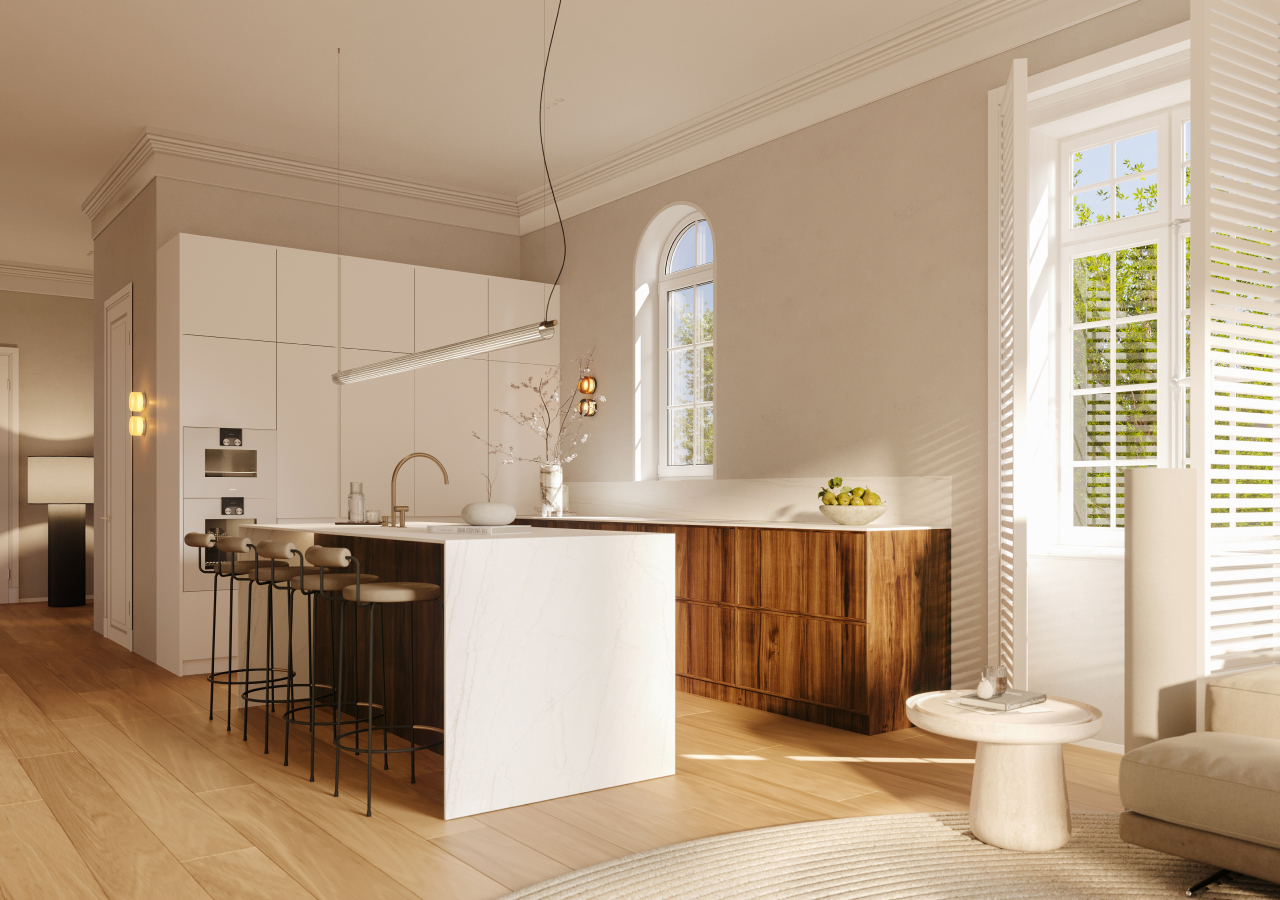
Natural light is one of the reasons European kitchens often feel larger and calmer than their square footage suggests. It makes materials look honest and reduces visual noise, especially when paired with matte finishes and a restrained palette. If you have large windows or glass doors, the kitchen can feel bright and airy during the day with surprisingly little artificial light.
That said, natural light changes constantly and can’t replace a layered lighting plan. The goal is to let daylight do what it does best, while your task and ambient layers make the kitchen consistent and comfortable at any hour. If privacy or glare is an issue, soft-filter window treatments tend to preserve the calm European feel better than heavy shades. Natural light should support the system, not be the system.
One Soft-Glow Layer that Makes the Kitchen Feel Calm
.webp)
A lot of kitchens fail at night not because they’re under-lit, but because they’re lit only by overhead fixtures and a bright task layer. That combination can feel flat and clinical once the sun goes down. The fix is adding one low-output “soft glow” layer that gives the room depth without demanding attention.
Toe-kick lighting is the easiest win because it creates a subtle floating effect and makes nighttime navigation gentler. Shelf lighting adds warmth where people look naturally, and cabinet interior lighting makes pantry storage more usable while feeling quietly luxurious. This layer is usually best when it’s dimmable or triggered by sensors, since its job is mood and usability, not brightness.
Conclusion
The most successful European-style kitchens feel easy because nothing is fighting for attention, and lighting plays a bigger role in that than most people expect. When task, ambient, and accent lighting each have a clear purpose, you get counters that are truly usable, a room that feels evenly lit without harsh hotspots, and a softer glow that makes the space feel lived-in at night.
The goal is the right light in the right places, with separate controls so the kitchen can shift from work mode to evening mode. If you start with your layout, mark the zones, and build the layers from there, the fixture selection becomes the final step instead of a guessing game. Corner can help you translate that plan into cohesive choices that fit your kitchen and your style.


