
.webp)
Cabinets do more than hold dishes. They set the kitchen’s proportions, determine how efficiently you move between sink, cooktop, and storage, and decide whether the room feels calm and intentional or visually busy. The stock vs custom choice is rarely about “good vs bad.” It’s about constraints and priorities: budget, timeline, how unusual your layout is, how picky you are about finishes, and how long you want the kitchen to last before it feels tired.
Stock cabinets can be a smart, fast solution for standard rooms, especially if you spend strategically on hardware and organization. Custom cabinets shine when the space demands precision, when you want a seamless built-in look, or when storage needs to match how you actually cook and live. In this comparison, we’ll break down the differences, benefits, and trade-offs so you can choose the right option for your kitchen.
Stock vs Semi-Custom vs Custom Cabinets
| Factor | Stock cabinets | Semi-custom cabinets | Custom cabinets |
|---|---|---|---|
| Cost range | Lowest | Mid-range | Highest |
| Lead time | Fastest | Medium | Longest |
| Layout flexibility | Low | Medium | High |
| Materials | Limited | More options | Fully selectable |
| Hardware + storage | Basic to moderate | Moderate to high | Any configuration |
| Long-term value | Best for short horizon | Balanced | Best for longevity + fit |
What Are Stock Cabinets?
.webp)
Stock cabinets are mass-produced in standard sizes and finishes. You choose from a catalog of preset widths, heights, depths, and door styles, then design your layout around those modules. They are appealing because they are easy to source quickly and typically cost less upfront. The downside is that your kitchen often has to adapt to the cabinet system, which can create fillers, awkward gaps, and less efficient storage in anything but a very standard room.
Key idea: Stock is fastest and cheapest, but you trade away fit and finish control.
What Are Custom Cabinets?
.webp)
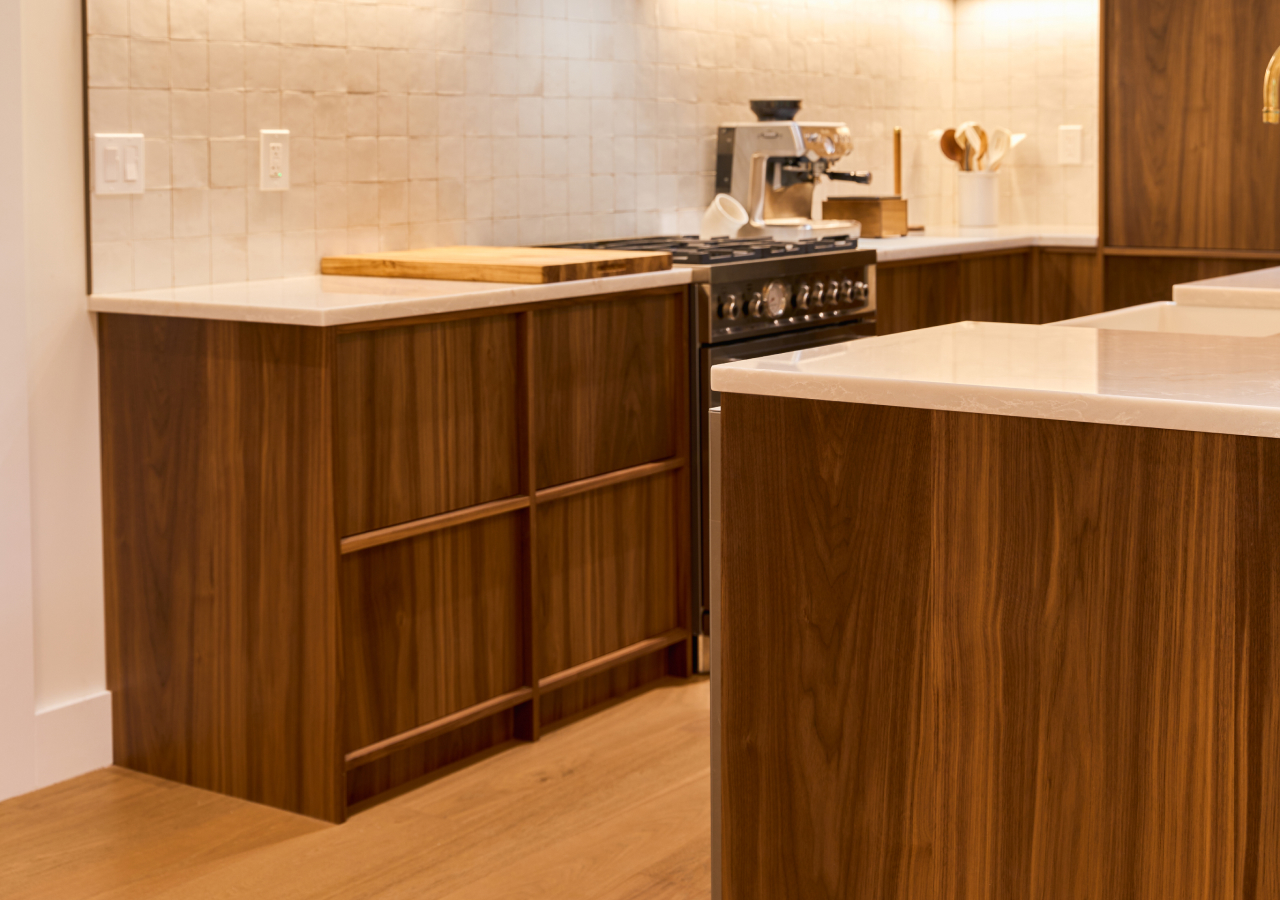
Custom cabinets are built to a specific plan for your space. Dimensions can be tailored to the inch, and you can specify materials, door construction, interior storage, and hardware. This is how you reduce layout compromises and create cleaner lines, especially if you want a built-in look with fewer visual breaks. Custom also makes it easier to design storage around your habits rather than around default cabinet assumptions.
Key idea: Custom cabinetry is about precision and control: fewer compromises in layout, function, and appearance.
Where Semi-Custom Fits
Semi-custom sits in the middle. You start with a manufacturer’s system, but you can adjust sizes and details within their rules. In practical terms, semi-custom often solves the most common stock problems (limited sizing, limited finish options, limited upgrades) without moving all the way into full custom cost and timeline.
Key idea: Semi-custom is often the best value bridge when stock does not quite fit but full custom is not necessary.
Cost: What You Actually Pay For
Cabinet costs are driven by a few predictable variables: how much cabinetry you need, the construction level, the finish system, storage accessories, and complexity. Complexity is the quiet driver that catches people off guard because it is not one line item. Islands, tall pantry walls, corners, appliance garages, and integrated panels add parts, labor, and hardware.
A practical way to sanity-check your quote is to count the “special items.” If your plan includes multiple tall units, corner solutions, a panel-ready fridge, or a detailed island, you should expect pricing to move toward the higher end regardless of whether the cabinets are stock, semi-custom, or custom.
Lead Time: Why “Quick” Is Not Always Quick
.webp)
Lead time is not only manufacturing. It includes design decisions, ordering, delivery coordination, and installation scheduling. Stock cabinets can be fast if the exact sizes and finishes you need are available immediately, but “in stock” does not always mean “complete.” One missing cabinet can slow an entire install.
Semi-custom typically requires build-to-order production, which adds time but still follows a standardized system. Custom usually takes the longest because the process includes design refinement, material selection, shop drawings, production, finishing, and professional installation. If you have a hard deadline and the kitchen is straightforward, stock or semi-custom often lowers schedule risk.
Quality: Materials, Construction, and What “Durable” Really Means
.webp)
Quality is a mix of box construction, finish durability, and hardware performance. Stock quality varies widely: some lines are solid and some are built to hit a price point. That is why it is risky to judge stock cabinets only by the door style or the showroom look.
Semi-custom cabinets is often where you can get the biggest quality upgrade for the money, because you gain access to better finish options, stronger drawer systems, and more reliable hardware upgrades without fully custom labor.
Custom gives you the most control over the specification of cabinet design. You can prioritize what matters in daily use: strong drawer boxes, premium hinges and slides, durable finishes around high-wear areas, and interiors that match your storage habits. One detail that changes the lived experience quickly is organization. Better drawers and smart pull-outs can improve usability dramatically, but they also add up across a full kitchen.
Layout and Design: Where Stock Starts to Break
.webp)
Stock works best when your kitchen is standard: straight runs, common appliance sizes, and no unusual ceiling, soffit, or corner constraints. Once the room gets more specific, the limitations show up as fillers, dead zones, and forced compromises. A kitchen can still look fine with stock, but it is harder to make it look seamless, especially in minimalist or built-in designs where every gap reads.
Custom becomes valuable when the room demands precision or when you have a strong design goal like minimal seams, perfect symmetry, or a continuous furniture-like wall. If your layout needs many fillers, has large dead corners, or creates awkward gaps, you are already paying for stock through reduced function and visual noise.
Long-Term Value: What Lasts and What You End Up Redoing

Stock can be the right choice if you plan to remodel again, if you are upgrading a rental, or if the kitchen is not a long-term home. In those cases, speed and reasonable function can matter more than perfect fit.
Custom tends to be worth considering when you want the kitchen to stay “current” longer because the layout is clean and intentional, and because the materials and hardware are chosen for longevity. Long-term value is not only resale. It is also fewer repairs, fewer annoying daily compromises, and a kitchen that still feels good after years of use.
When Stock Cabinets are Enough
.webp)
Stock makes sense when the room is predictable and you mainly need a clean, functional layout without paying for precision. If the cabinet modules line up naturally with your walls and appliances, stock can look great and perform well, especially if you upgrade the parts that get the most daily use.
- Your kitchen footprint is standard and the plan fits common cabinet sizes
- You need the fastest path to a functional kitchen
- Budget is the primary constraint
- You are renovating a rental, starter home, or short-horizon property
- You can accept a few compromises (fillers, less optimized storage)
Tip: If you go stock, put money where you feel it: better hinges and slides, smarter drawer interiors, and a finish you can live with daily.
When Custom Cabinets Are Worth It
.webp)
Custom is worth it when the space or the design goal is specific enough that standard modules create permanent compromises. If you care about clean lines, exact alignment, and storage that matches how you actually live, custom buys control, and that control is what you end up feeling every day.
- The layout is unusual, tight, or full of constraints
- You want a seamless, built-in look (especially with tall runs and integrated appliances)
- You care about specific materials, veneer matching, or premium finishes
- Storage needs are complex (heavy cookware, pantry systems, hidden zones)
- You want fewer compromises and a longer service life
Tip: Custom value comes from precision. The more your plan relies on perfect fit, the more custom pays off.
How to Decide on Cabinets in 6 Steps (Fast and Practical)
- Map constraints. Confirm ceiling height, soffits, windows, vents, plumbing, and appliance sizes.
- Estimate cabinetry length. Rough out linear feet of base and wall runs so you can sanity-check pricing.
- Choose the priority. Decide what matters most: lowest cost, fastest timeline, best fit, or best design outcome.
- Spot the dealbreakers. Look for fillers, dead corners, awkward clearances, or storage shortfalls that will annoy you daily.
- Set a spec baseline. Choose the construction level, finish type, and hardware quality you won’t compromise on.
- Compare quotes apples-to-apples. Use the same layout, the same hardware assumptions, and the same installation scope.
Conclusion
Stock and custom cabinets can both be the “right” choice, as long as they match your priorities and the reality of your space. If your kitchen is standard, your timeline is tight, or budget is the main constraint, stock (or semi-custom) can deliver a strong result, especially when you upgrade the parts that affect daily use, like hinges, slides, and drawer organization. If your room has constraints, you want a seamless built-in look, or you care most about long-term durability and a layout that feels effortless, custom is usually worth the premium because it removes compromises you’ll otherwise live with for years.
The best way to decide is to compare options with the same layout and assumptions, then choose based on what you want to optimize: speed, cost, design control, or longevity. When those priorities are clear, the decision becomes straightforward.
FAQ: Stock Cabinets vs Custom Cabinets
What are the three types of cabinets?
Cabinets generally fall into three categories: stock, semi-custom, and custom. Stock cabinets are mass-produced and ready to install, semi-custom options allow limited adjustments, and custom cabinets are built from scratch to fit your exact space and preferences.
What is the difference between custom cabinets and stock cabinets?
Stock cabinets are affordable, quick to install, and come in standard sizes with limited finishes. Custom cabinets are tailored to your kitchen, made from higher-quality materials, and offer complete flexibility in design, layout, and storage.
How much do stock kitchen cabinets cost?
Prices vary by manufacturer, but stock cabinets are the most budget-friendly option. A basic setup may cost just a few thousand dollars, while modular versions with upgrades are more, though still far less than custom designs.
What are the advantages of custom cabinets?
Custom cabinets fit your space perfectly, give you full choice of materials and finishes, and allow for unique layouts and storage solutions. They are built to last longer than stock cabinets and add lasting value to your kitchen.


