
.webp)
A well-proportioned kitchen island usually starts around 60 × 120 cm and scales up to about 90 cm deep and 180–240 cm long in larger rooms. The key is to keep 90–105 cm of clear circulation around the island, and 105–120 cm behind stools, so workflow, storage, and seating all feel natural instead of cramped.
Part of our kitchen island planning guide. Related: island height, island vs peninsula.
A kitchen island can be the quiet anchor of a modern European kitchen, organizing workflow, adding storage, and creating a natural gathering place. Think of the island as a pillar: it sets the rhythm of the room and holds the workflow together. In Japandi and Scandinavian kitchens, especially, the island is where calm aesthetics meet everyday practicality. But for that to work, size and proportions matter just as much as materials.
An island that is too big can choke movement; too small, and you lose precious counter space. This guide walks through clear, modern standards so the kitchen island feels balanced, functional, and perfectly scaled to your minimalist or family kitchen. It’s about smart organization, not just adding another surface.
Why Kitchen Island Size Matters in a Modern Kitchen
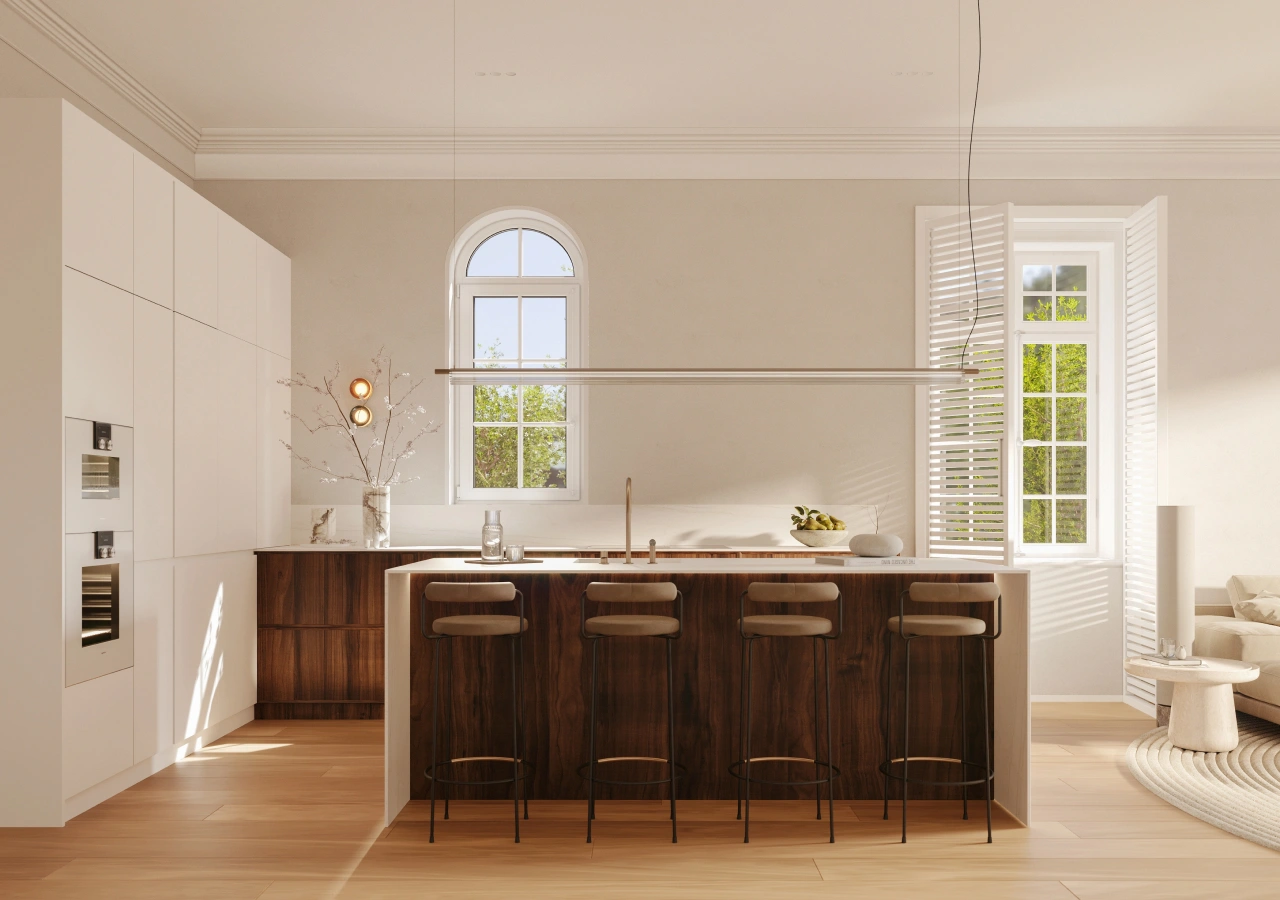
In a well-planned European kitchen, the island behaves like a small piece of architecture rather than a freestanding block. A European-style kitchen island is sized to protect movement and clear sightlines, not just to add mass in the middle. It shapes how you move between the fridge, sink, and cooktop, how many people can cook at once, and where everyone naturally gathers. When the size is right, the kitchen island becomes a centre of gravity: you prep on one side, unload the dishwasher on another, and still have space for someone to sit with a laptop or a cup of coffee.
Sensible sizing leaves room for doors and drawers to open, prevents collisions when someone walks behind you, and gives you a generous but reachable work surface. It also decides how much storage you actually gain: deeper drawers, better organised zones for cookware and dishes, and a clear home for small appliances instead of clutter across every surface. Visually, the kitchen island design sets the tone of the room: in a Japandi kitchen, the wrong scale can make it feel heavy instead of sculptural; in a Scandinavian kitchen, an oversized island can block light and kill the airy feeling.
Standard Dimensions for Modern Kitchen Islands
.webp)
Most successful modern European kitchen island designs are built around a few reliable standards. As a starting point, 60 × 120 cm is a realistic minimum for a fixed island: enough space for a run of cabinets with drawers and a usable worktop. From there, the island grows longer or slightly deeper depending on what you ask it to do.
For many modern European kitchens, a depth of around 90 cm works well. This gives space for full-extension drawers, comfortable prep zones, and, if needed, a shallow overhang for stools. Going much deeper starts to make the centre harder to reach, which is why Corner’s projects tend to favour compact depths with smarter internal storage rather than massive slabs of stone.
Height matters too. The standard working height for a kitchen island is about 90–91 cm, matching the rest of the countertops so your prep surfaces line up cleanly. That height is comfortable for everyday cooking. If you want the island to behave more like a bar or high dining counter, you can move up to around 105 cm instead, or adjust slightly for very tall households and baking-heavy routines.
Length is where the kitchen island really scales to your space. At the compact end, 120–140 cm will support storage and a practical prep area. In larger kitchens, 180–240 cm allows you to combine deep drawers, a sink or hob, and casual seating without overcrowding. The key is to let dimensions grow while still protecting the clearance around the kitchen island and keeping its footprint in proportion to the room, so it remains a calm focal point instead of a roadblock.
| Island type | Typical length (cm) | Typical depth (cm) | Clearance around island (cm) | Seating guideline |
|---|---|---|---|---|
| Minimum fixed island (storage + prep) | ≈ 120 | ≈ 60 | ≥ 90 | No seating |
| Comfortable prep island | 140–180 | 80–90 | 90–105 | No or occasional seating |
| Island with 2 seats (small kitchen) | 120–150 | 80–90 | 105–120 behind stools | ≈ 60 cm width per person |
| Island with 3–4 seats (open-plan) | 180–240 | ≈ 90 | 105–120 behind stools | ≈ 60 cm width per person |
| Dining-focused island | 200–240 | 90–100 | 105–120 | 3–4 seats on one/two sides |
Clearances for a European-Style Kitchen Island
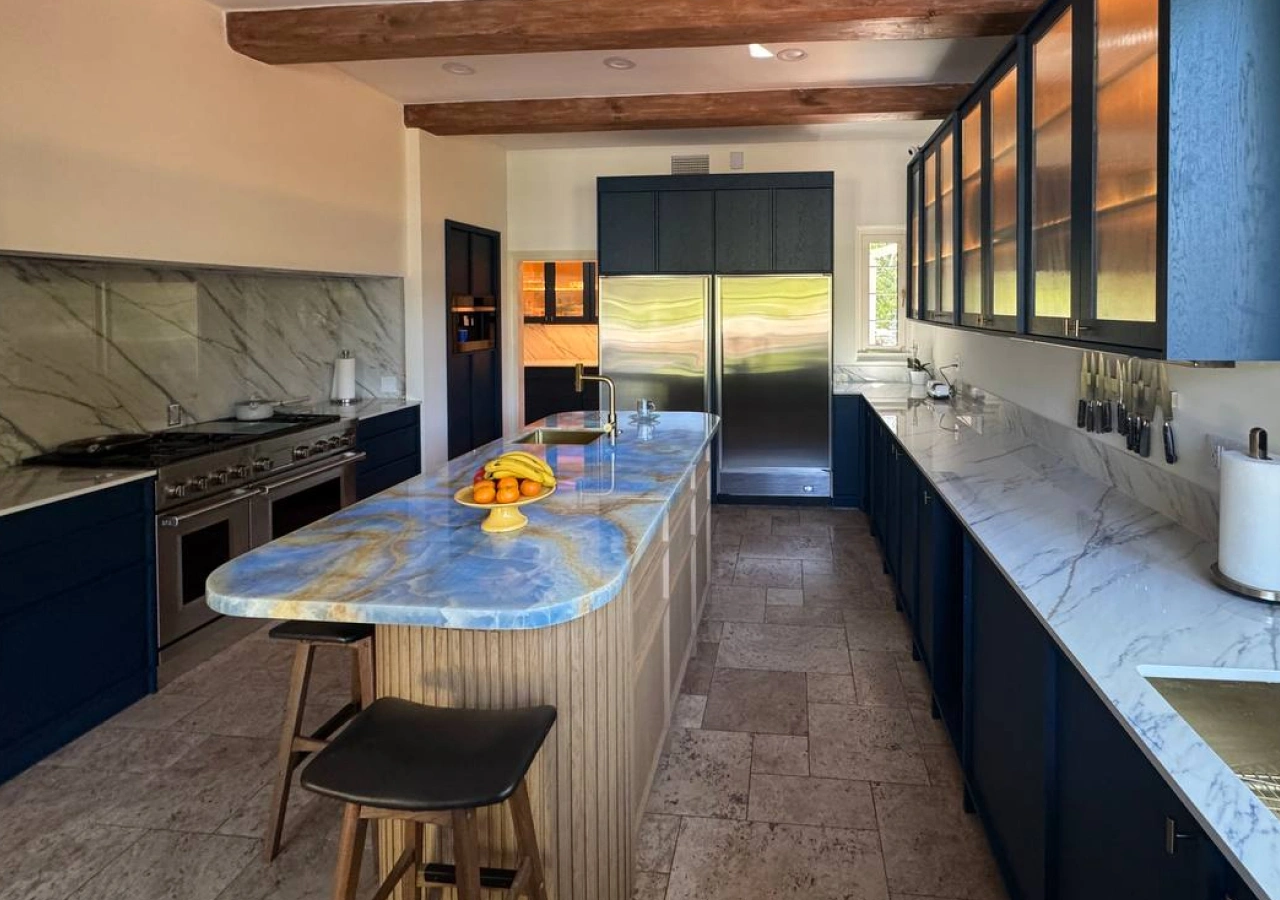
Even the most beautiful kitchen island will feel wrong if circulation is tight. Across multiple guides and idea pieces, one number keeps coming back: 36 inches (about 90 cm) of clear walkway around the island design is the bare minimum.
From there, the rules refine depending on how you use the space:
- Basic movement: 36–42 inches (90–105 cm) from the cabinet to the island is enough for doors and drawers to open and for one person to pass comfortably.
- Seating or busy households: when you add stools, Corner recommends pushing that to 42–48 inches (105–120 cm) behind the seating side, so someone can walk past a seated person without squeezing.
- Worked example: if your room is 108 inches (about 2.75 m) wide, the widest kitchen island you want is around 36 inches (91 cm) deep, leaving 36 inches on each side.
In real life, these clearances are what make an open-plan European kitchen feel effortless: someone can prep at the hob, another can unload the dishwasher, and kids can loop around the kitchen island without traffic jams. In a small kitchen, they’re even more important—often the decision is between a slim fixed island or a mobile island that can be tucked away, rather than forcing a block that ruins the flow.
Kitchen Island Size Variations
Not every kitchen island has to solve the same problem. Some are quiet storage powerhouses, others behave more like a café counter, and some are designed to replace a dining table. The way you size the island should follow its primary role.
Kitchen Islands for Storage

A storage-focused kitchen island acts as the central organiser of the kitchen. The priority is a comfortable working depth and a well-planned internal layout rather than maximum seating. For many modern European kitchen layouts, a depth of around 90 cm works well. It gives room for full-extension drawers on the working side and, if needed, shallow cupboards or open shelves on the back. When the kitchen island carries most of your pots, pans, dishes, and small appliances, you can free the walls for windows, lighter upper cabinets, or open shelving and keep the room visually calm.
Kitchen Islands with Seating
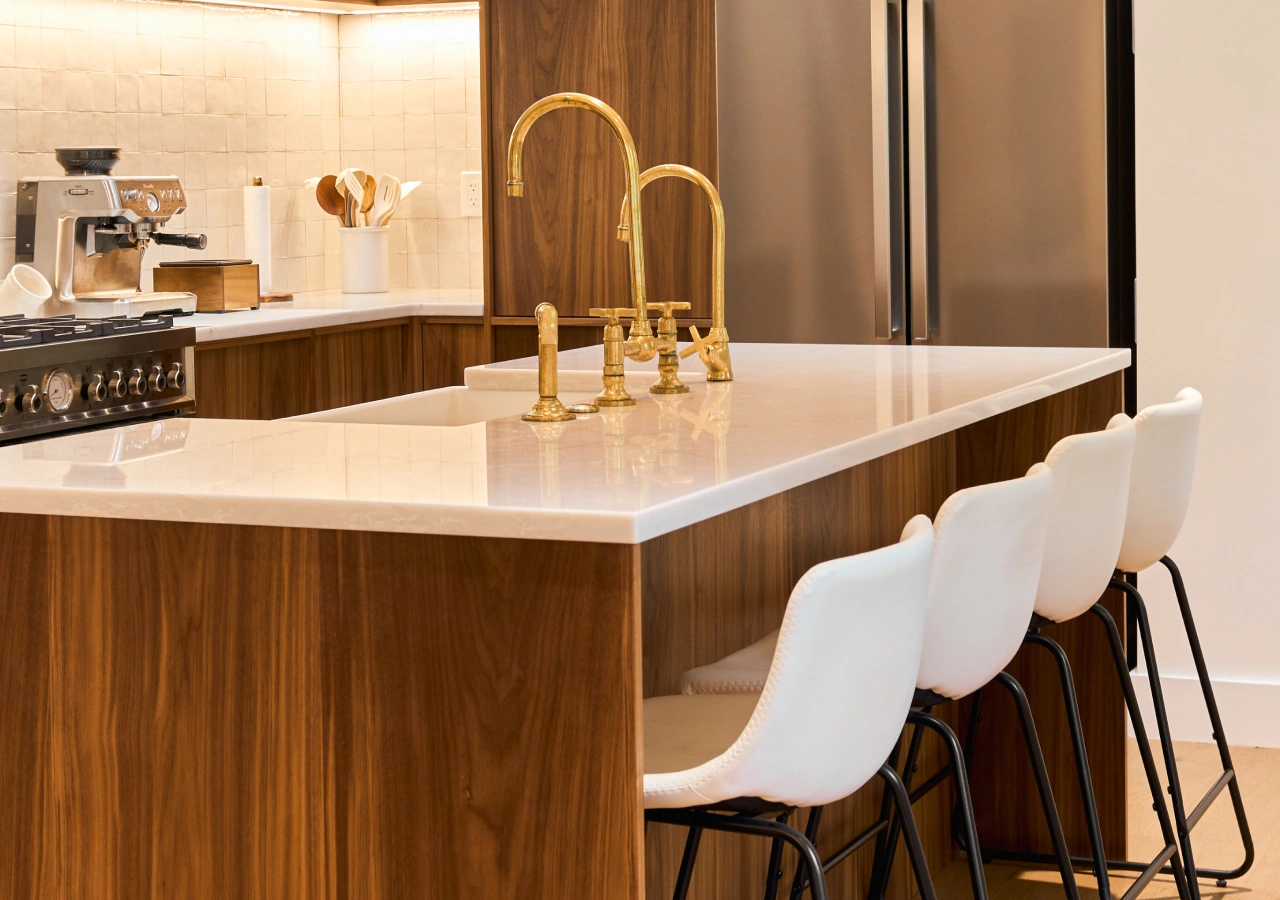
Once you introduce seating, the kitchen island starts to work as a social hub as well as a workstation. Each person needs roughly 60 cm of width to sit comfortably, so even a small kitchen island with two stools is rarely shorter than 120 cm. The overhang should be deep enough for knees to tuck underneath, and you still need generous clearance behind the stools so people can move past easily. In open-plan European and Scandinavian kitchens, this often becomes the natural spot for coffee, conversation, and quick meals.
Kitchen Islands as a Dining Area
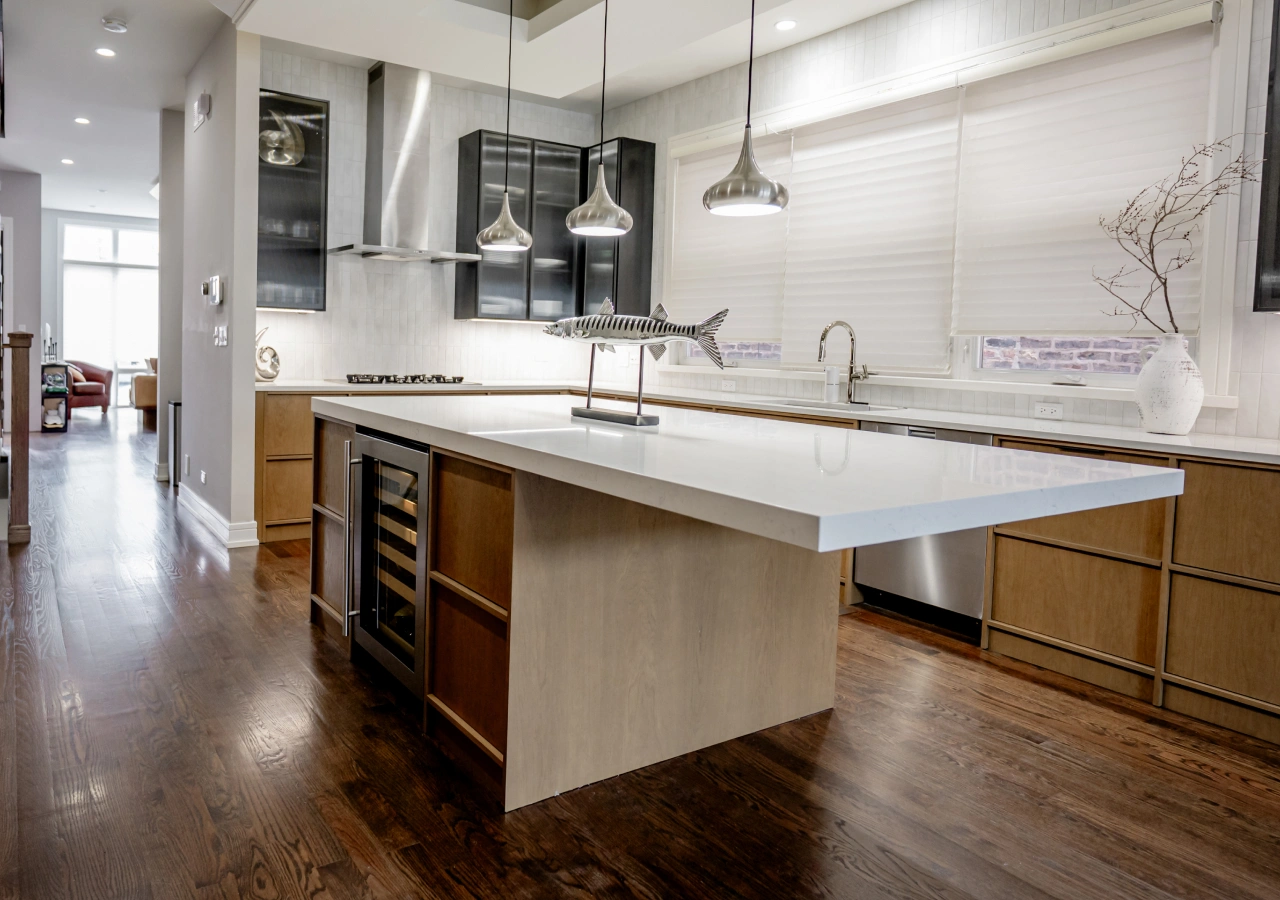
When the kitchen island doubles as a dining area, it needs to feel more like a built-in table than a pure prep block. The footprint usually grows a little longer to seat three or four people in a row or on two adjacent sides. Some homeowners prefer a single height at standard counter level; others opt for a raised bar-height section that gently separates cooking from eating. In Japandi and Scandinavian interiors, softened edges and table-like legs at the seating end help the island feel lighter and more furniture-like while still following the same spacing rules.
Minimum Island Sizes for Different Kitchen Types

Not every space can (or should) fit a massive block in the middle. Corner’s island guides repeatedly emphasize choosing an island type that matches the room: fixed, slim, table-style, or even mobile.
Here’s how the same dimension rules play out in different layouts:
- Small kitchen
In a small kitchen, you’re usually working close to that 60 × 120 cm minimum, or considering a movable island that can be pulled out when needed. The priority is preserving 90–105 cm of circulation on all sides. A slim kitchen island with drawers on one side and maybe shallow shelves on the other is often more realistic than a deep, double-sided unit. In a small European kitchen, a slim island often works best when it behaves like an extra prep run, not a full dining bar. - Galley or narrow European kitchen
In compact European kitchens with islands, the “island” sometimes becomes a peninsula or a tailored piece aligned with one wall. The same rules apply—clearance comes first—but you might only have room for seating on the far end rather than along the long side. Kitchen islands that double as storage and a coffee station work well in these compact, minimalist kitchens. - Open-plan Scandinavian or Japandi kitchen
In larger rooms, the kitchen island can reach 200–240 cm in length while still staying within the “10% of kitchen area” guideline and the clearance rules. At that size, you can combine: drawers, integrated appliances, and 2–4 seats. Corner’s Berlin Scandinavian kitchen with its walnut Japandi islands are good examples—large enough to define zones, but not so large that they feel like a barrier.
Kitchen Island Dimensions in Inches: US Quick Reference
The same standards in imperial units, for US kitchens and NKBA-style planning.
| Measurement | Standard (inches) | Metric |
|---|---|---|
| Minimum fixed island | 24 × 48 in (2 × 4 ft) | 60 × 120 cm |
| Comfortable depth | 32–36 in | 80–90 cm |
| Length with 3–4 seats | 71–94 in | 180–240 cm |
| Counter height / bar height | 36 in / 42 in | 90–91 cm / 105 cm |
| Walkway on working sides | 36–42 in | 90–105 cm |
| Behind stools | 42–48 in | 105–120 cm |
| Counter width per seat | 24 in | 60 cm |
| Knee space under the overhang | 15 in at 36 in high; 12 in at 42 in high | 38 cm / 30 cm |
| Island footprint | about 10% of the kitchen floor area | same |
The work triangle and where the island may sit
The classic kitchen triangle connects the refrigerator, the sink and the cooktop; each leg should be between 4 and 9 ft (1.2–2.7 m). If the island does not hold one of those stations, it should intrude no more than 12 in (30 cm) into the triangle. If it carries the sink or the hob, it becomes one of the three points and the other legs are measured to it.
Working space around a sink or cooktop on the island
Leave at least 18 in (45 cm) of landing space on one side of a sink, and 15 in (38 cm) on one side plus 12 in (30 cm) on the other side of a cooktop. A cooktop on the island also needs ventilation: an overhead hood is the usual answer; a downdraft vent works but is harder to install over a concrete slab.
Outlets: what the code expects
In the US, island countertop receptacles must be GFCI-protected, and the NEC sets a minimum count that grows with the countertop area. Where they can go without spoiling the panels is covered in Outlets on kitchen islands.
Mobile islands
A rolling island suits a small kitchen that cannot keep the clearances for a fixed one: it gives extra prep space when needed and moves away when not. It cannot carry outlets or plumbing, so treat it as a worktop and storage piece.
Common Kitchen Island Sizing Mistakes

Most kitchen island problems are not about the finish or the colour; they come down to size and placement. One of the biggest mistakes is simply forcing an island into a room that is too tight. On paper, the dimensions might fit, but once you account for appliance doors and real bodies moving around, the circulation disappears. That’s when cooking becomes a sequence of “excuse me” moments, and the island stops feeling like an upgrade.
Another common issue is oversizing the kitchen island in relation to the rest of the kitchen. In a Japandi kitchen, this can overwhelm the delicate balance between negative space and solid volumes. In a Scandinavian kitchen, it can interrupt daylight and lines of sight, making everything feel heavier. The kitchen island should be strong enough to anchor the space, not so dominant that it blocks every view.
Finally, people often underestimate how much space seating really needs. Squeezing four stools into a run that’s comfortable for three leads to crowded, awkward everyday use. Similarly, keeping only a narrow gap behind those stools means anyone passing through has to twist sideways and brush past the seated person. All of these issues can be avoided by respecting the standard widths per seat and the circulation zone behind them during the planning stage.
How to Choose the Right Kitchen Island Size for Your Home
- Measure the room and mark clearances: Sketch the kitchen and draw a 90–105 cm “no compromise” ring around the proposed island. If you cannot keep that distance, switch to a smaller footprint, peninsula, or mobile island.
- Define the island’s primary job: Decide whether the island is mainly for storage, prep, seating, or dining. A storage-focused island can stay more compact, while a social island usually grows longer and reserves one side for stools.
- Check the 10% rule: Compare the island’s footprint to the total kitchen floor area. If it pushes far beyond about 10%, trim the size so the island feels integrated into the room instead of like a block dropped in the middle.
- Overlay your style: In Scandinavian kitchens, slim down the volume or use table-like legs and open shelves to keep it light. In Japandi kitchens, consider a solid form with warm veneer and softened corners so it reads as a sculpted piece of furniture.
- Test it with low-tech tools: Mock up the island with a table, cardboard, or painter’s tape and walk the space. Stand where the hob, sink, and dishwasher will be to see if clearances and seating actually feel comfortable in real life.
Conclusion
A well-proportioned kitchen island is one of the most powerful tools you have when redesigning a kitchen. It can turn a small kitchen into a highly organised space, bring clarity to an open-plan Scandinavian-style space, or create a serene focal point in a Japandi interior. When you respect clearances, choose realistic standard dimensions, and size your island for the way you actually live, the result feels effortless: more storage, better workflow, and a natural place for people to gather.
If you’re renovating your kitchen and want a refined yet practical kitchen island, explore Corner’s Scandinavian, Japandi, and modern European kitchen collections. You can also schedule a short design call to review your layout with a designer.
FAQ: Kitchen Island Size & Modern European Standards


