
.webp)
Curved kitchen cabinets change more than the outline of the kitchen. Once a cabinet moves away from a straight line, the layout, construction method, storage shape, and cost change with it. Curved cabinetry needs to be planned early, not added at the end as a visual flourish.
For homeowners who want a kitchen to feel less rigid, curves can soften heavy forms and make movement through the room easier. They can also help large elements, especially islands, sit more comfortably within an open space. Curved cabinets also ask more from fabrication, finishing, and installation. Below, we’ll look at what curved kitchen cabinets are, why designers use them, where they work best, and when they are not worth the trade-off.
Curved Kitchen Cabinets at a Glance
What Are Curved Kitchen Cabinets?
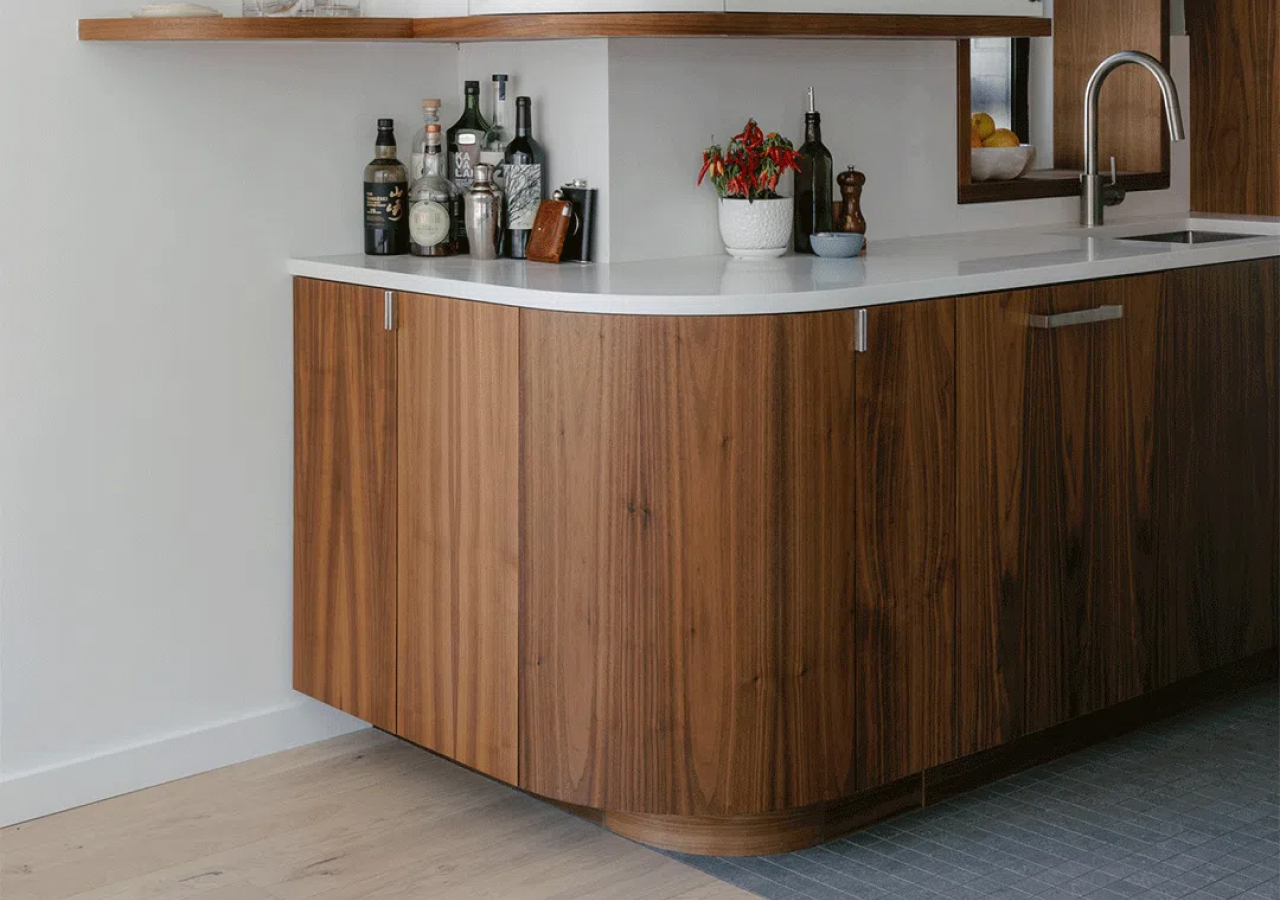
Curved kitchen cabinets use a rounded radius instead of a straight cabinet edge, so they need custom construction. The cabinet box has to follow the curve, the front has to be made for that shape, and the end details often need more planning than they would in a standard straight run. Countertops, end panels, plinths, and fillers also need to be resolved differently.
In most kitchens, curved cabinetry appears in a limited number of places. It is most often used on an island end, at the exposed end of a cabinet run, or at a corner where the kitchen changes direction. That targeted use usually makes more sense than trying to repeat curves throughout the room.
This is also why curved cabinets should not be thought of as a decorative add-on. They are a structural cabinet decision from the start.
Why Designers Use Curved Cabinets
.webp)
Designers use curved cabinets because modern kitchens often rely on straight lines, flat planes, and sharp transitions. That can look clean and controlled, but if every edge is square, the room can start to feel hard. A curve softens the run without depending on trim, ornament, or contrast.
This is especially useful in kitchens that already lean toward minimalism. Handleless cabinetry, slab doors, and quiet material palettes all benefit from one element that loosens the geometry slightly. Curves can do that while keeping the kitchen disciplined and uncluttered.
They also help large elements feel less bulky. A rectangular island often reads as one solid block at the center of the room. A rounded edge breaks up that mass and makes movement around it feel easier. That is one reason curves sit comfortably in Scandinavian and Japandi kitchens, where the room often depends on warmth, light, and restraint rather than statement details.
Functional Benefits That Matter
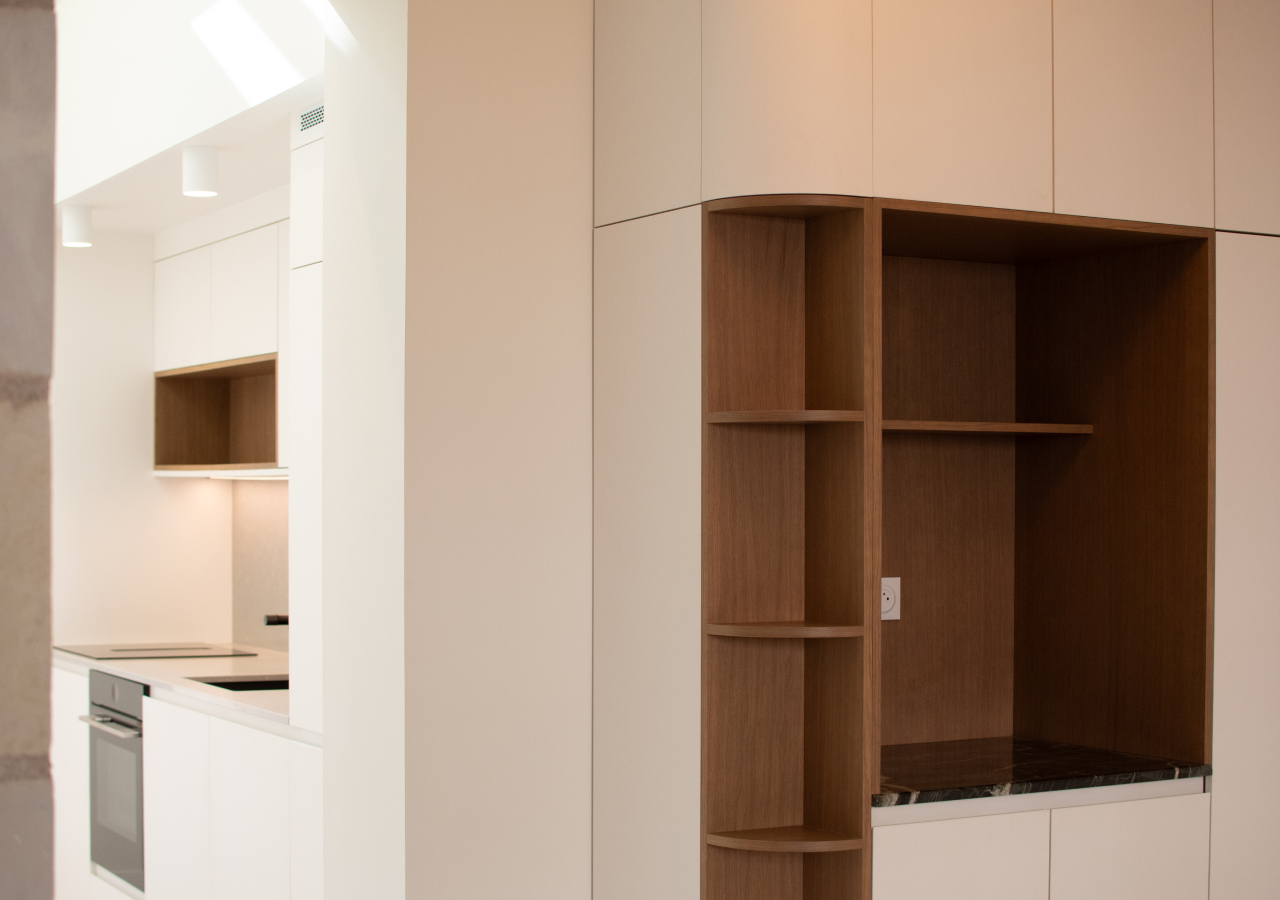
Designers use curved cabinets to change the shape of the kitchen without adding decorative detail. In kitchens built around slab fronts, handleless systems, and simple material palettes, every line matters. A rounded edge can interrupt a run of hard angles and give the room a gentler profile.
That matters most in kitchens where the cabinetry takes up a large part of the visual field. An island, for example, often sits in the center of the room as a strong block. Rounding one end can make it feel less abrupt and easier to relate to the surrounding space.
Curves also sit naturally within Scandinavian and Japandi kitchens, where the emphasis is usually on restraint, natural materials, and a quieter overall look.
Where Curved Cabinets Work Best
.webp)
Curved cabinets work best in places where a hard edge would feel exposed, awkward, or too heavy. The most common example is a kitchen island. Because the island is usually the most prominent object in the room, changing one end from square to rounded can alter the feel of the entire center zone.
Another good place is the end of a cabinet run that opens into a dining area, hallway, or living space. A curved end gives that transition a cleaner finish than a blunt stop.
Some kitchens also benefit from a radius corner where one run turns into another. This can make the kitchen read as one continuous composition instead of a series of disconnected blocks.
Curves do not need to appear everywhere to be effective. In most cases, one or two carefully chosen curved elements are enough.
Best Places to Use Curved Cabinets
Materials and Finishes for Curves
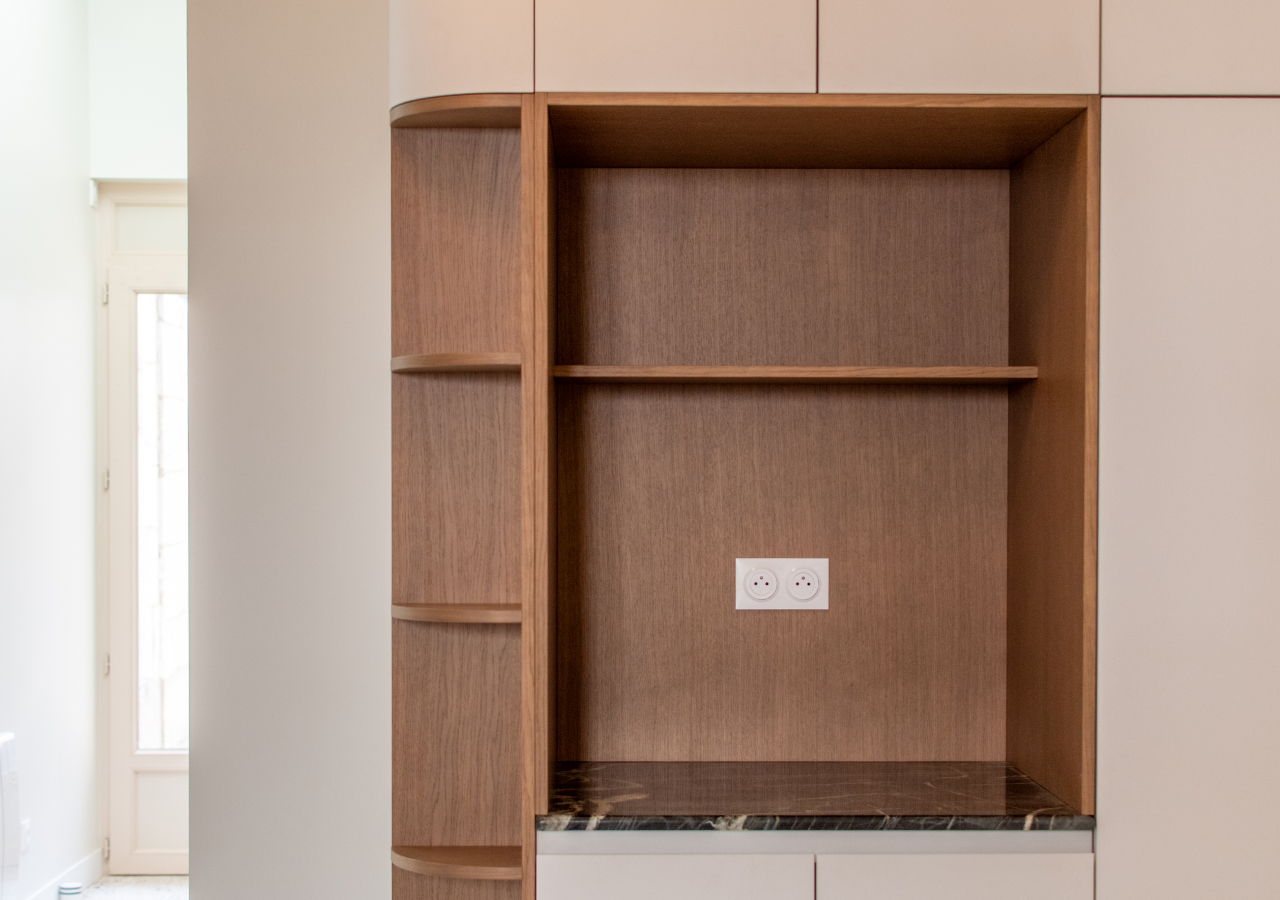
Wood veneer is usually the most natural finish for curved kitchen cabinets because it can wrap a radius more cleanly than most rigid materials. Oak and walnut are especially useful here. They bring warmth, texture, and enough depth to make the curve feel intentional rather than decorative.
Painted or lacquered finishes can also work well, particularly when the kitchen is meant to look more monolithic. But curves demand tighter control in finishing. Once a surface bends, any unevenness, rippling, or inconsistency becomes easier to notice in changing light.
Laminate is usually more limited, especially on tighter radii. It can work on softer curves, but it is rarely the strongest choice when the curve is meant to be a defining feature. It is better suited to broader, simpler forms.
Fluted or ribbed fronts can be used on curves, but they add another level of difficulty. The spacing has to remain even and the rhythm has to stay clean around the bend. When that control slips, the whole surface can start to look distorted.
Stone is the most complicated material here. A curved island with a stone top or stone cladding needs more advanced detailing, careful joint planning, and a higher budget. The result can be beautiful, but it is rarely simple.
Material Comparison for Curved Cabinets
Pros and Cons of Curved Kitchen Cabinets
.webp)
Curved cabinetry can make a kitchen feel more custom, less rigid, and more relaxed visually. It softens large volumes, improves movement around key edges, and can change the feel of the room with one rounded element.
The drawbacks are just as clear. Curved cabinets are harder to fabricate, harder to install, and usually less storage-efficient than straight cabinetry. As soon as the internal shape changes, it becomes harder to use that volume as cleanly as a standard drawer stack.
Installation also becomes more demanding. Small irregularities in floors, walls, or adjoining pieces show up faster around a smooth radius than they do on a straight cabinet. With curved cabinetry, execution matters more than the idea itself.
Curved Cabinets vs Straight Cabinets
Cost and Customization
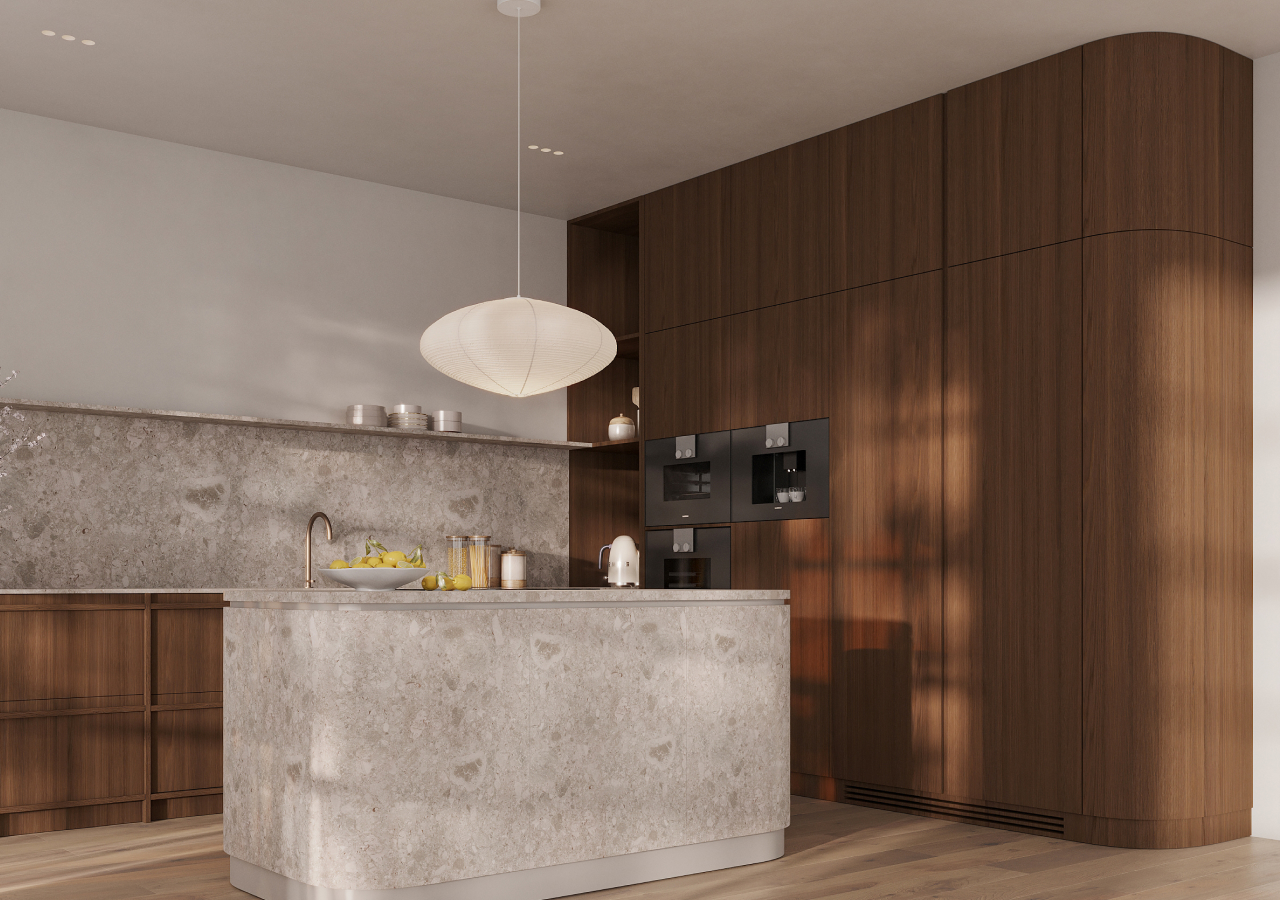
Curved cabinets are a custom feature and should be treated that way from the start. The extra cost comes from design time, custom fabrication, more demanding finishing, and tighter installation requirements. If the design includes stone, the cost usually rises again because the detailing becomes more complex.
That does not mean curves only make sense in very large kitchens. In many projects, a single curved element is enough. A rounded island end or softened cabinet transition can deliver most of the visual benefit without pushing the whole kitchen too far into custom territory.
The curve has to earn its place in the layout. If it improves movement, softens a heavy form, or cleans up a transition, the cost is easier to justify. If it is only there to look different, it can feel expensive very quickly.
When to Avoid Curved Cabinets
.webp)
Curved cabinets are not always the right choice. In very compact kitchens, straight cabinetry usually makes better use of space. In budget-sensitive projects, the money may be better spent on stronger hardware, better storage systems, or higher-quality finishes.
They can also feel unnecessary in kitchens with a very strict linear architecture. And if the fabricator or installer does not have real experience with curved work, it is better to avoid it. This is one of those details that depends heavily on execution.
Conclusion
Curved kitchen cabinets are not just a visual feature. They are a real design and manufacturing decision that changes how a kitchen is built, used, and experienced. When handled well, they soften the room, improve movement, and create a more tailored sense of calm. When handled poorly, they add cost and complexity without improving function enough to justify it.
That is why the best use of curves is usually selective. A well-placed curved island edge or softened cabinet transition can do more than a kitchen full of rounded elements. If you are considering curved cabinetry, the goal should be to use it where the visual and practical payoff are both clear.
To see how these ideas connect with softer palettes and material choices, explore Scandinavian White Kitchens and Japandi Materials, or browse Corner Renovation’s kitchen collections for more real-world design direction.


